Services
Custom website design, as a purchase
Custom website design in Australia — no fixed scope to fall back on, which is what makes it worth paying more for, and worth defining precisely first.
In short. "Custom website design" means a site built to a scope drawn up for that one project, not assembled from a fixed template. It costs more because there is no existing structure to fall back on, and it is worth it only when the business genuinely needs something a template cannot do.
“Custom website design” means the site is built to a scope written for that one project, rather than assembled inside an existing template’s structure. It is worth paying for when the business needs something a template genuinely cannot do, and it is not worth paying for as a way of signalling quality — quality and customisation are different purchases, and suppliers benefit from you not noticing the difference.
Measured for Australia and recorded in research/national-volume-au.json, “custom website design” draws 140 searches a month at a keyword difficulty of 67 — high for a term with that volume, which usually means competition from more than one type of publisher. The result page pulled for this exact phrase and read title by title in research/serp-candidates.json confirms it: five of seven results are design-inspiration galleries and portfolio showcases, not agencies selling a service. Only two are service pages. That is not a strong buying signal, and this page is written as an honest explainer rather than a sales pitch, on the strength of what the search results actually show.
What “custom” changes from a templated website build
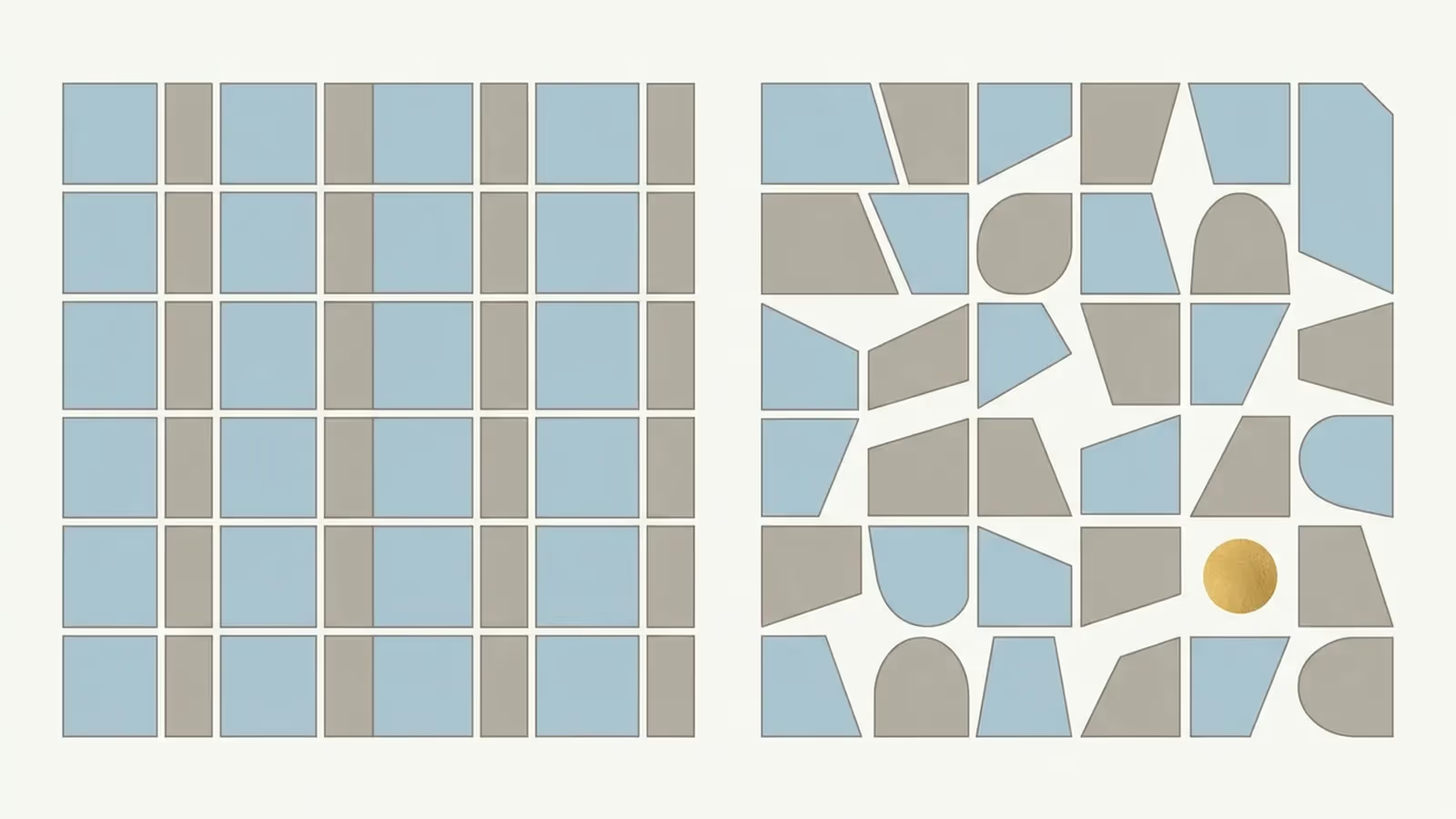
A templated build starts from an existing structure — a theme, a page builder’s layout library, a platform’s built-in blocks — and populates it with your content. A custom build starts from a blank canvas and writes the structure itself.
That single difference cascades. There is no existing code to inherit, so everything from the grid system to the way a form validates has to be specified and built. There is no library of pre-tested layouts, so more design and development time goes into things a template would have handled for free. And there is no shared codebase with thousands of other sites finding its bugs, so testing carries more weight.
What you are actually paying the premium for
Not “better design.” Templates can be designed well and custom builds can be designed badly — customisation is a statement about how the site is constructed, not about how good it looks.
What the premium buys is the removal of a constraint. If your business genuinely needs a page layout, an interaction, or a piece of functionality that no template or page-builder offers, a custom build is the only way to get it without compromise. Common genuine triggers: an unusual product configurator, a booking flow with rules a generic plugin cannot express, a data visualisation specific to your industry, or an integration with an internal system that has no off-the-shelf connector.
| Situation | Template usually sufficient | Custom usually justified |
|---|---|---|
| Standard brochure site, a handful of page types | Yes | No |
| Online store with standard product/cart/checkout | Yes (platform-native) | Rarely |
| Unusual interactive tool or configurator | No | Yes |
| Integration with a bespoke internal system | No | Yes |
| Design that must not resemble any competitor’s site structurally | Sometimes | Often |
The question that separates a genuine custom build from a relabelled template

Ask what happens if you request a layout or interaction the platform’s page builder does not offer natively. A supplier doing genuine custom work answers “we would write that”, because there is no existing structure constraining the answer. A supplier who answers “we would use the closest built-in option instead” is describing a themed build, whatever the quote calls it.
This matters because “custom” is one of the most inflated words in web design sales copy. A theme with a changed colour palette and a new logo is routinely sold as a custom website. The word costs nothing to write into a proposal, and a buyer who does not ask the question above has no way to tell the difference from the outside.
What it costs, in structure rather than figures
A custom build removes the free labour a template provides — pre-built layouts, tested interaction patterns, a large community finding and fixing bugs before you ever see them — and replaces it with time billed directly to your project. That is the entire reason it costs more: nothing is amortised across thousands of other users of the same code.
What drives the cost of a website sets out the general cost structure that applies to any build; a custom build simply removes several of the cost-reducing assumptions a templated build gets to make (existing layouts, existing patterns, wider testing), which is why the same scope costs more when it is built from nothing.
When to choose the cheaper option instead
If nothing about the business genuinely requires bespoke functionality, a well-built site on an established platform will do the job at a lower cost and with less risk, because you inherit a large amount of tested work for free. When a template is the right answer sets out that side of the decision in more depth than belongs on a page about the custom option.
What to ask before agreeing to pay for “custom”
Name, in one sentence, the specific thing your site must do that a template cannot. If you cannot write that sentence, you are very likely paying a premium for a word rather than for a capability. Take that sentence to website design services as a starting point for what a build actually involves, and use it to test any supplier’s claim that your project requires a custom build before you agree to pay for one.
Evidence for this page
This page exists because the demand below was measured, not assumed. The figures are search-market data about the topic — they are not prices.
- Entity this page targets
- custom website design
- Measured Google volume
- 140 searches/month, Australia
- Keyword difficulty
- 67 of 100
- Advertiser cost per click
- 19.68 AUD CPC
- AI assistant volume
- no data
- Advertiser competition
- LOW (index 18 of 100)
- Measured on
- 3 August 2026
- Search results inspected for intent
- No
2 other phrasings resolve to this same page
custom web design · bespoke website design
Keyword difficulty of 67 is high for a term with only 140 searches a month — a signal that design galleries and portfolio sites (Behance, Dribbble, Awwwards-adjacent pages) are competing for the phrase, not just agencies. That matches the SERP read directly above.
Source: research/national-volume-au.json + research/cpc-competition-au.json + research/serp-candidates.json · DataForSEO Labs and SERP classification, location_code 2036 (Australia), language en · pulled 3 August 2026.
Provenance
Written by Australian Website Design. Published 2026-08-04, last updated 2026-08-04.
Sources
- National keyword volume and difficulty, Australia —
research/national-volume-au.json(accessed 2026-07-31) - Advertiser cost-per-click and competition, Australia —
research/cpc-competition-au.json(accessed 2026-07-31) - Search result classification for this page's canonical target —
research/serp-candidates.json(accessed 2026-08-04)