Pricing
Website design cost: what drives the price in Australia
Website design cost in Australia: what the money buys, which decisions move it most, what to ask about the quote in your hand, and what GST adds.
In short. The cost of a website in Australia is driven by scope, the number of distinct page designs rather than pages, who writes the content, integrations, migration of an existing site, and everything that happens after launch. A quote that does not state its GST treatment is not yet a price. The figures on this page are withheld until the dataset behind them is reviewed and released.
The cost of a website in Australia is not one number, and any page that gives you one AUD figure without conditions attached is either guessing or selling. That holds whether the quote comes from a Sydney, Melbourne, Brisbane, Perth, Adelaide or Gold Coast web design studio, or from a supplier working remotely. What follows is the structure underneath the number: what the money is actually buying, which decisions move it most, what to ask about the quote in your hand, and what GST does to the figure once it lands on the invoice.
This question is asked constantly. Measured for Australia on 31 July 2026 and recorded in research/national-volume-au.json, the cost query and its close variants draw around 390 searches a month between them, at a keyword difficulty of 9 with competition indexed at 50, which tells you advertisers are paying to intercept it. AI assistants recorded 553 prompts for the cost phrasing in June 2026 and 468 for the plain-language question, from research/ai-vol-keywords.json and research/ai-vol-questions.json. The prompt volume has been sliding month on month since April, which is worth noting mostly as a reminder that answers given to a machine are not stable ground.
What actually drives website cost in Australia

Scope, meaning what the site has to do
The single largest variable is not design. It is the number of distinct jobs the site is being asked to do. A site whose job is “explain what we do and let someone ring us” is a fundamentally different piece of work from one that has to take bookings, gate a member area, or feed enquiries into a CRM. Every additional job adds design work, build work, testing, and a permanent maintenance obligation.
Before you compare any two quotes, write down in one sentence what the site must do. If two quotes are answering different sentences, their figures cannot be compared at all.
Page count, from a basic brochure site to something larger
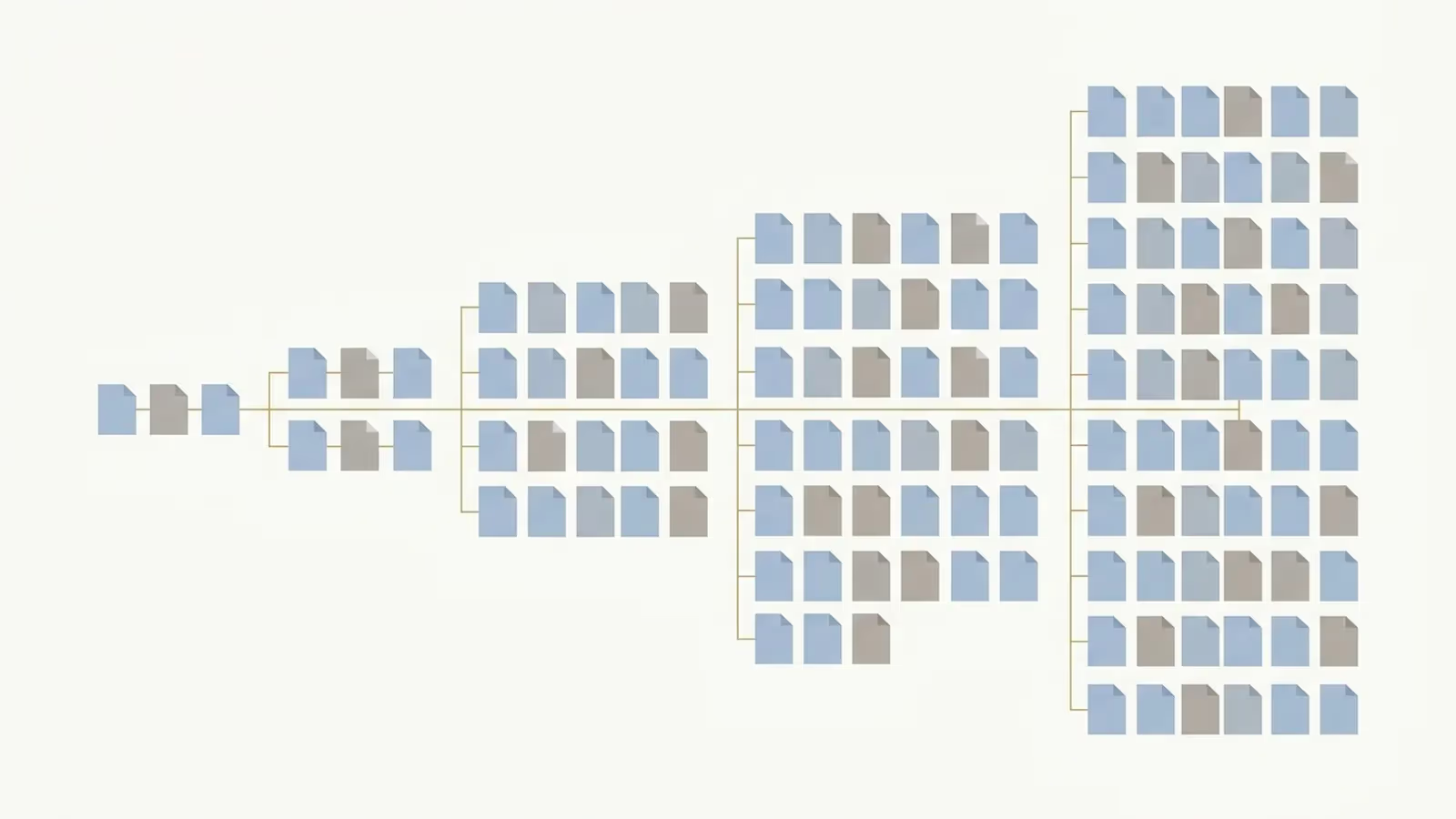
Page count is the number most often used to size a website, and it is a poor proxy on its own. Twelve pages built from four repeating layouts is a smaller job than six pages that each need their own layout. What costs money is the number of distinct templates, not the number of URLs poured into them.
Ask any supplier how many unique page designs are in the quote. The answer is more informative than the page count, and a supplier who has thought about the build will have it immediately.
Content, which is where most budgets quietly break
Content is the most underestimated line in web projects, and the most common cause of a build stalling. Someone has to write the words. Someone has to source or shoot the photographs. Someone has to gather the licence numbers, the service areas, the staff bios and the legal pages.
If the quote does not say who does that, the assumption is almost always that you do. That is not necessarily wrong. It is only a problem when nobody says it out loud, and the project sits for months waiting on content that the client did not know was theirs.
Get this stated explicitly: who writes the copy, how many rounds of revision are included, who supplies photography, and what the build does if content arrives late.
Web design, and whether it is made for you or adapted
There is a real and legitimate range here, and neither end is dishonest. A theme or template adapted with your colours, type and photography is a valid, basic answer for many businesses, and it is faster and cheaper because most of the web design decisions have already been made. A custom design built from your business outward costs more because someone is making those decisions again, specifically for you.
What matters is that you know which one you are buying. A quote that describes a bespoke, custom web design and delivers a lightly recoloured theme is the most common complaint in this trade.
The platform underneath the design also moves the number. A WordPress build, a WooCommerce store, or a fully custom development each carry a different cost shape. WordPress and WooCommerce development spreads cost across cheaper build time and ongoing plugin and hosting fees. A custom development build front-loads more design and development cost, in exchange for fewer ongoing licence dependencies. Neither platform choice is inherently the cheaper one, once the ongoing cost of website maintenance is added to the build cost. That is why comparing two Australian web design quotes on build price alone, without asking what platform each one assumes, compares two different products as if they were one.
Integrations, ecommerce and WordPress or other platform choices
Every connection to something outside the website adds cost, and adds it twice: once to build and once to keep working. Booking systems, payment gateways, CRMs, accounting packages, email platforms, inventory systems, review widgets. Each has its own quirks, its own updates, and its own capacity to break without warning when the other party ships a change.
Ask which integrations are in the quote, who holds the accounts, and who fixes it when one of them stops working six months from now.
Migration, if a site already exists
Replacing a site is not the same as building one. If your existing site has pages that rank, are linked to, or are printed on a vehicle, those addresses have to be mapped to their new equivalents or the traffic and the search visibility go with them. Content has to be moved, checked, and in most cases rewritten. Old media has to be brought across at usable quality.
Redesign quotes that are silent on redirect mapping are the ones that produce a traffic collapse a fortnight after launch. It is preventable, it is not expensive to do properly, and it is skipped constantly.
| What it is | Typical | Range | Projects |
|---|---|---|---|
| Redesign of an existing site | Withheld — not yet reviewed | ||
Figures not published. The pricing dataset has not been reviewed and released, so no figure is shown here. The site is built to refuse to render prices in this state rather than show a provisional number. What is published and what is not.
Why every figure on this page is withheld (6 reasons)
- dataset status is "PLACEHOLDER_UNREVIEWED", not "VERIFIED"
- dataset publishable is false, not true
- GST treatment has not been stated — ACL s48 requires it explicitly, at equal prominence
- the dataset has not been dated — undated figures are not citable
- the collection method has not been written down — an unsourced figure is an assertion
- no band passes the band-level audit
Ecommerce and hourly-billed work sit outside the standard bands
An ecommerce build is its own cost shape, not a variant of a brochure site. An ecommerce site built on WooCommerce, Shopify or a custom cart carries its own pricing pattern: product-catalogue size, payment integrations and freight rules push the number around in ways a page-count estimate cannot capture. The specifics of ecommerce pricing are covered on ecommerce website design in Australia. Work priced hourly rather than at a fixed AUD figure moves for a different reason: the total depends on how much genuinely gets discovered as the project runs, not on a scope agreed up front. An hourly rate of a few hundred AUD an hour is common for this kind of open-ended work. Ask which basis — fixed, packaged or hourly — a quote actually uses before comparing it against another quote priced on a different basis; how web design work is actually priced sets out what each pricing basis shifts onto you.
Everything after launch: hosting, domain and website maintenance cost
A website is not a purchase, it is a thing you own that requires upkeep. Hosting, domain renewal, platform and plugin updates, backups, security patching, and the small changes every business needs. If a quote covers only the build, the ongoing cost is still real and it is now yours to organise. That is covered in full on maintenance as a recurring line.
What GST does to a quoted design cost figure in AUD

If a quote does not state its GST treatment, you do not yet know the price.
GST adds ten per cent. A figure quoted exclusive of GST becomes ten per cent larger on the invoice, which on a project of any size is a material amount of money that many owners discover at the wrong moment. When a service is quoted to a consumer, the total price payable is meant to be stated in a way that is at least as prominent as any component of it. Yet across the nine Australian cost pages checked on 31 July 2026 and recorded in research/pricing-bands.json, none states GST treatment at all.
There is a second layer to this. If your business is registered for GST, the GST on a website build is generally claimable as an input tax credit, which means the real cost to you is the excluding-GST figure. If you are not registered, the including-GST figure is what it costs you, full stop. Two businesses can receive the same quote and bear genuinely different costs. Your accountant can tell you which one you are in about thirty seconds, and it is worth asking before you compare quotes rather than after.
So: ask whether the figure is inclusive or exclusive, and get the answer in writing. It is a fair question, it takes one line to answer, and how a supplier reacts to being asked is informative in itself.
What to ask about any website development quote
Take these to whoever has quoted you. None of them are hostile questions, and all of them should have quick answers.
- Is this figure inclusive or exclusive of GST.
- What is the total payable, including GST, and what is the payment schedule.
- Who owns the design files, the code, the content and the domain when the final invoice is paid. Get it in writing.
- Which registrar and which hosting account holds the site, and is it in my name.
- How many unique page designs are included, and how many rounds of revision.
- Who writes the copy, and who supplies the photography.
- What is included after launch, for how long, and what happens on day one after that period ends.
- Which third-party services carry their own ongoing fees, and roughly what they are.
- What happens if the project is not delivered, and what portion of what I have paid is recoverable.
- Will the site be handed over in a form another supplier could take on, or is it locked to a proprietary platform.
The last one is worth dwelling on. A site you cannot take elsewhere is not really yours, whatever the invoice says, and the moment you discover that is usually the moment the relationship has already gone wrong.
Why a range of costs is more honest than a number
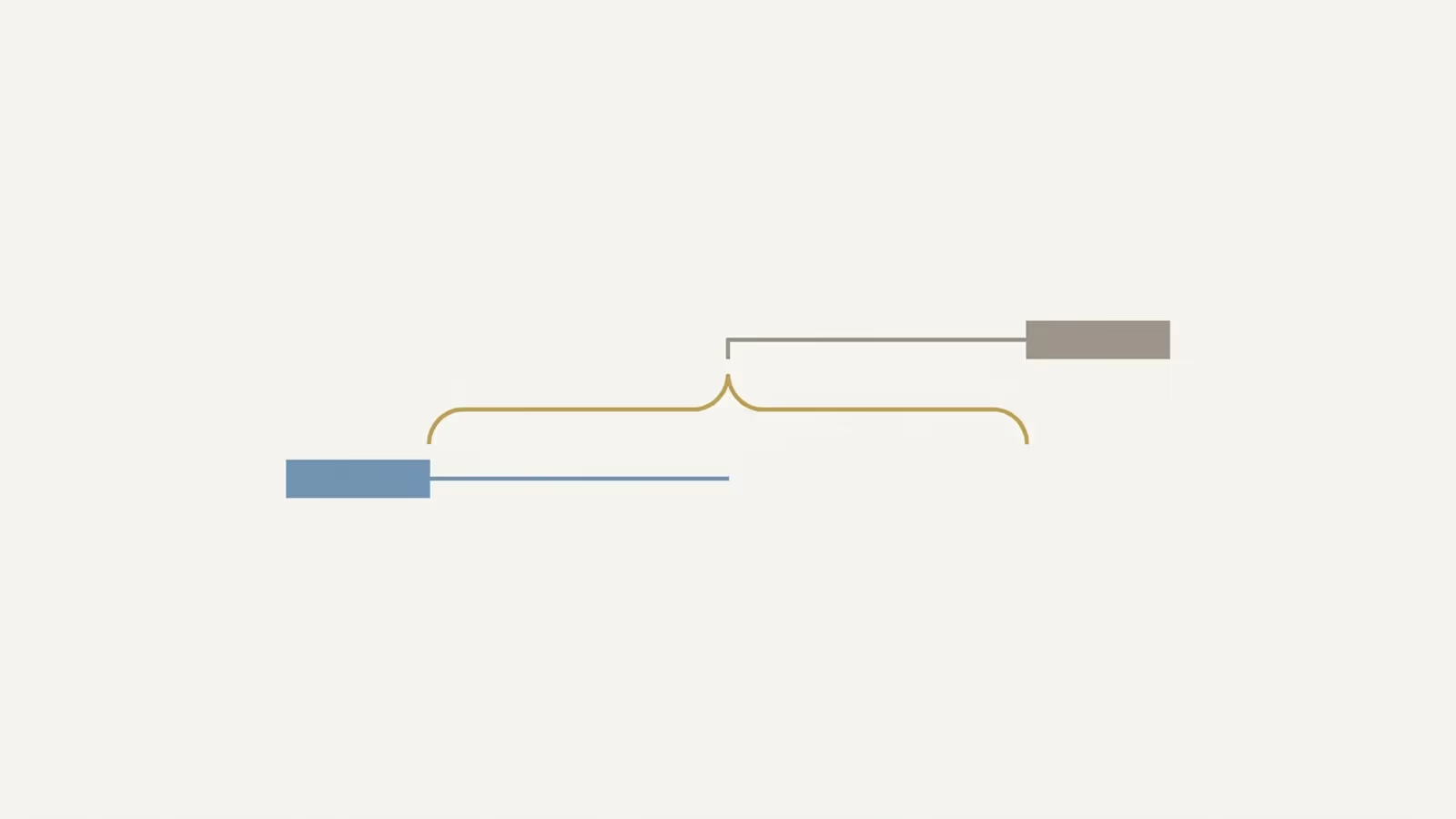
A single figure implies a precision nobody has. The same brief, sent to five capable Australian suppliers, comes back at five different figures, and they are not all wrong. They reflect different amounts of included content work, different levels of design originality, different assumptions about revisions, and different views of what happens after launch.
A range says something true: work of this description tends to land in a given AUD region, and where your job sits inside it depends on things a page cannot know about you. A single number says something false, but it says it in a more comforting way, which is why single numbers are what get published as pricing.
A range is only honest if the conditions travel with it. A range with no scope, no date, no sample size and no GST treatment is not more honest than a number. It is just vaguer.
Common questions about website cost
Is a website quote inclusive or exclusive of GST? It depends on the supplier, and if the quote does not say, you do not yet know the price. GST adds ten per cent. Ask for the total payable including GST in writing. Across the nine Australian cost pages checked on 31 July 2026, none stated GST treatment at all.
Who owns a website once it is paid for? Whoever the contract says owns it. Ownership of the design files, the code, the content and the domain is set by agreement, not by custom, and it is not automatically the client. Get it in writing before you pay a deposit.
Why do quotes for the same brief vary so much? Because the same brief sent to five capable suppliers is answered with five different assumptions about included content work, design originality, revision rounds, and what happens after launch. The figures differ because the scope differs, and comparing them requires making those assumptions explicit.
Why the figures on this page are withheld
There are no dollar amounts on this page, and that is not an oversight.
The dataset that will supply them is marked PLACEHOLDER_UNREVIEWED, and the site is built to refuse to render a figure while that flag is set. The build fails rather than publishes. That guard exists because the alternative, publishing figures that feel about right, is exactly what the rest of this topic already does, and it is why nobody can check anything.
When the figures are released they will carry the number of projects behind each band, the period they cover, the scope each band describes, and their GST treatment. Bands with too few projects behind them will be withheld rather than published, because a band drawn from a handful of jobs can identify the clients in it. The full state of the dataset is set out in the dataset behind these bands.
| What it is | Typical | Range | Projects |
|---|---|---|---|
| Small business brochure site | Withheld — not yet reviewed | ||
| Standard business website | Withheld — not yet reviewed | ||
| Custom designed website | Withheld — not yet reviewed | ||
Figures not published. The pricing dataset has not been reviewed and released, so no figure is shown here. The site is built to refuse to render prices in this state rather than show a provisional number. What is published and what is not.
Why every figure on this page is withheld (6 reasons)
- dataset status is "PLACEHOLDER_UNREVIEWED", not "VERIFIED"
- dataset publishable is false, not true
- GST treatment has not been stated — ACL s48 requires it explicitly, at equal prominence
- the dataset has not been dated — undated figures are not citable
- the collection method has not been written down — an unsourced figure is an assertion
- no band passes the band-level audit
Until then, this page is the part that actually helps: the structure of the cost, and the questions that make a quote legible. A figure would tell you where you sit. The structure tells you what you are buying, which is the thing most owners are never given.
If you are being sold a fixed bundle rather than a scoped project, read fixed-scope packages next, and small business scopes if the business is small enough that most of a package would go unused.
Two of the drivers above are really engineering questions rather than pricing ones. What the site is built on, and whether an existing site can be migrated without losing its search visibility, are covered on development work in Brisbane. How to scope the job before you ask anyone to price it is on what a small business site has to do.
Evidence for this page
This page exists because the demand below was measured, not assumed. The figures are search-market data about the topic — they are not prices.
- Entity this page targets
- website design cost
- Measured Google volume
- 390 searches/month, Australia
- Keyword difficulty
- 9 of 100
- Advertiser cost per click
- 9.76 AUD CPC
- AI assistant volume
- 553 prompts/month
- Advertiser competition
- MEDIUM (index 50 of 100)
- Measured on
- 31 July 2026
- Search results inspected for intent
- Yes — research/serp-commercial.json — pulled 3 August 2026 for this page's OWN canonical target "website design cost" and classified by hand, title by title. 8 of 8 agency-published cost guides — the same competitor set audited in research/pricing-bands.json.
3 other phrasings resolve to this same page
web design cost · website design prices · how much does a website cost in australia
"website design cost", "web design cost" and "website design prices" return identical volume (390), difficulty (9), advertiser cost (9.76 AUD CPC) and competition index (50). That identity is what marks them as one entity. The volume is counted once, not tripled. AI-assistant demand differs across the three phrasings and is summed separately: 553 plus 167 plus 47 for June 2026, with a further 468 prompts for the plain-language question.
Source: research/national-volume-au.json + research/cpc-competition-au.json + research/ai-vol-keywords.json · DataForSEO Labs and AI Optimization, location_code 2036 (Australia), language en · pulled 31 July 2026.
Provenance
Written by Australian Website Design. Published 2026-07-31, last updated 2026-07-31.
Sources
- National keyword volume and difficulty, Australia —
research/national-volume-au.json(accessed 2026-07-31) - Advertiser cost-per-click and competition, Australia —
research/cpc-competition-au.json(accessed 2026-07-31) - AI-assistant prompt volume, Australia —
research/ai-vol-keywords.json(accessed 2026-07-31) - Audit of nine Australian competitor cost pages —
research/pricing-bands.json(accessed 2026-07-31)