What web design is
What web design is
Web design is the discipline of planning, designing and building a website. What it covers, who does it, what you receive, and what is specific to Australia.
In short. Web design is the discipline of planning, designing and building a website for a particular audience and a particular job. It covers purpose, structure, content, visual design, platform, performance, accessibility, and the terms the work is delivered under. In Australia it is also shaped by auDA domain licensing, the Disability Discrimination Act, the Australian Consumer Law and the Copyright Act.
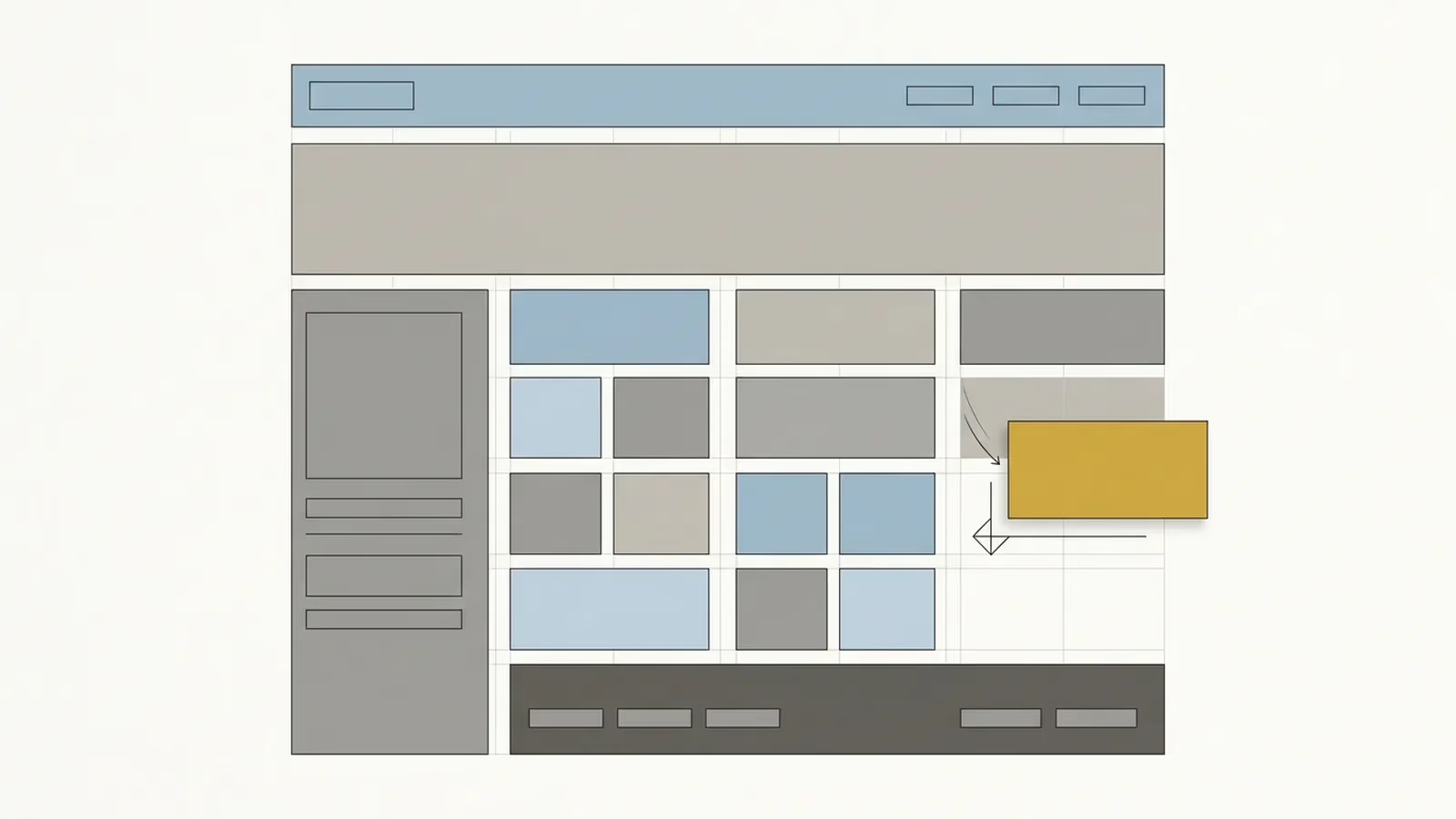
Web design is the discipline of planning, designing and building a website so that a defined audience can find it, read it, use it and act on it. It covers what the site is for, what is on it, how it is arranged, how it looks, what it runs on, how fast it loads, who can use it, and what you own when it is finished.
That is a broader definition than the one most advertising uses, and the breadth is the point. “web design” measures 8,100 searches a month in Australia at a keyword difficulty of 81, and the same phrase is used to sell a fifteen-page brochure site, a single landing page, an online store, a rebrand and a monthly retainer. The word does not narrow the purchase. This page narrows it, by naming the parts.
This is the root document for this site. Every other page here is about one of the parts named below, and links back to this one.
The parts a web design project is made of
A web design project is not one decision. It is a sequence of them, and a quote from a web design agency that names only some is not comparable to a quote that names others.
| Part | The decision it settles | Where it goes wrong |
|---|---|---|
| Purpose | What the site is for and who it is for | Never written down, so nothing can be judged |
| Structure | What pages exist and how they relate | Decided by the template rather than by the business |
| Content | The words, images and documents | Owed by the client, late, and it stalls the build |
| Visual design | Layout, typography, colour, imagery | Judged as taste rather than against the purpose |
| Platform | What the site is built on and who can edit it | Chosen before anyone asks who will maintain it |
| Performance | How fast it loads on a real connection | Measured on the builder’s desk, not the buyer’s phone |
| Accessibility | Whether people with disability can use it | Assumed rather than checked |
| Search readiness | Whether a search engine can crawl and understand it | Confused with search engine optimisation as a service |
| Ownership | Who holds the domain, the code and the accounts | Settled by silence, which favours the supplier |
| Maintenance | What happens after launch | Priced separately and discovered later |
Each row is a page or a cluster of pages on this site. If a supplier’s proposal is silent on a row, that is the question to ask.
Web design, web development and the words in between
The two words describe different work and are sold as though they describe the same work.
Web design decides what the site contains, how it is arranged, how it behaves for a person using it, and what it looks like. Web development builds the thing that does it: the templates, the database, the forms, the integrations. On a small business project one person very often does both, which is why the terms blur in advertising.
The blurring has a practical cost. Two quotes for “a website” can describe genuinely different scopes of work, and the cheaper one is sometimes the one that excludes the part you assumed was included. The difference between the two roles is set out on the difference between a web designer and a web developer, and web development services covers the engagement shape when the work is ongoing rather than a project.
Three adjacent disciplines are commonly bundled into a web design quote and are not web design.
Branding and graphic design
Branding and graphic design produce the logo, palette and identity. Web design applies them.
Copywriting
Copywriting produces the words. A web design build can be designed without them and cannot be finished without them.
Search engine optimisation
Search engine optimisation is an ongoing programme of work on a live site. What a site owes search engines at launch is a web design build question; what happens after that is a different discipline with different suppliers.
Who does web design work
| Role | What they are | What you are buying |
|---|---|---|
| Freelancer | One person, sometimes a sole trader with a business registration | Direct access, one point of failure |
| Studio or agency | A team, usually several roles | Coverage across roles, a layer between you and the work |
| Platform provider | A product with an editor, such as a website builder | Software and templates, not judgement |
| In-house | An employee | Continuity, and the cost of a salary |
None of these is the right answer generally. The question that separates them is who will hold the accounts and make changes in eighteen months.
The design and digital work inside a web design project: layout, interface, graphics and ecommerce
Underneath the phrase “web design” sit several distinct crafts a project draws on in different proportions depending on scope. Layout and interface design decide how a page is organised and how a person interacts with it. Graphics and iconography support that structure rather than replacing it. An ecommerce build adds a further layer — catalogue, checkout, payment — on top of the same interface work. None of this is delivered by a single generic “designer” role in practice; a small studio often covers all of it through one or two people, while a larger agency splits it across several web designers and specialists, and a digital strategy sitting above the visual work decides which of these crafts actually gets budget on a given project. Mobile-first design is now the default starting point for nearly all of it, because most Australian small-business traffic arrives on a phone first.
What a web design project produces
In the ordinary case a completed web design project produces a live site at your domain, the accounts that control it, the working files or platform access, and a written record of what was agreed and what was delivered.
Which of those you actually receive is a matter of contract, not custom. Under the Copyright Act 1968 (Cth) the person who creates a work generally owns the copyright in it unless it has been assigned, and an assignment of copyright must be in writing. That default sits behind a very common surprise at the end of a build, and it is set out on who owns your website.
What is specific to Australia
Most published writing about web design is written for the United States and quietly imports the wrong rules. Five things differ here and all five are checkable.
Domains
A .au name is licensed under rules published by auDA, not owned. Every registrant must have an Australian presence, and since 12 April 2021 the relationship between the name and the registrant is tested as a Match or a Synonym. The detail is on Australian domain eligibility.
Accessibility
The exposure in Australia comes from the Disability Discrimination Act 1992, not the Americans with Disabilities Act. The technical standard usually referenced is the Web Content Accessibility Guidelines, which define conformance levels A, AA and AAA, and the W3C states that AAA is not intended to be met across a whole site. See website accessibility in Australia.
Price presentation
GST is ten per cent and a figure quoted without its GST treatment describes two different amounts. The Australian Consumer Law contains a single price requirement. See GST on web design.
Privacy
The Privacy Act and the Australian Privacy Principles govern what a contact form may do with what it collects, and the small-business exemption is still in force at the time of writing.
Copyright
The contractor-owns-unless-assigned default described above is Australian statute, not a norm imported from somewhere else.
How web design work is judged
Three of the site’s qualities can be measured rather than argued about, and a supplier who resists measuring them is telling you something.
Speed
Core Web Vitals are Largest Contentful Paint, Cumulative Layout Shift and Interaction to Next Paint. Interaction to Next Paint is the current responsiveness metric; First Input Delay is no longer one of the three. Measure on a phone on a real connection, not on the builder’s desk.
Accessibility
Automated tools catch a portion of the criteria and cannot judge whether a page makes sense. The rest is a person testing with a keyboard and a screen reader.
Whether it produces enquiries
This is the only one the business owner can judge alone, and it takes months rather than weeks.
What web design costs
Cost is a function of scope, not of page count, and the two are routinely confused. The drivers are on what drives the cost of a website, and every figure published on this site states its GST treatment because a figure without it is not yet a price.
If you are at the start, the fastest way to make quotes comparable is to write down what you are asking for before you ask. The project brief generator produces that document.
Where to go from here
- You are about to commission a website. Start with what a small business actually needs, then what drives the cost of a website.
- You are comparing platforms. Start with comparing platforms and approaches.
- You are in a regulated industry. Start with what a website has to do differently by industry.
- You want the vocabulary first. Start with a glossary of web terms.
Every section this site covers
This page is the root document. Every section below expands one part of it into its own cluster of pages.
Deciding and buying. Choosing and engaging a web designer · What websites cost in Australia · Tools for pricing and briefing a website · Comparing website builders
Planning a build. Writing a website brief · Website structure and information architecture · Website content and copy planning · Design decisions a website buyer actually has to make · Website basics for first-time buyers
Platforms and the technical build. Website platforms and content systems · Website builds by platform · Domain names and .au eligibility · Hosting and email · Selling online — the mechanics · Responsive design and mobile devices · Website performance · Website security · Accessibility in practice · What a new website owes search engines
Once it is live. The website build process, end to end · Redesign and migration · Website maintenance · When something is already wrong · Measuring what your website actually does · Getting enquiries from a website
Reference. A glossary of web terms · The Australian rules that apply to a business website · How the web design industry works · Research and original data
Who it is for. What a website has to do differently by industry · The separate pieces of a website project · Web design by location in Australia
Evidence for this page
This page exists because the demand below was measured, not assumed. The figures are search-market data about the topic — they are not prices.
- Entity this page targets
- web design
- Measured Google volume
- 8,100 searches/month, Australia
- Keyword difficulty
- 81 of 100
- Advertiser cost per click
- 16.58 AUD CPC
- AI assistant volume
- 1,503 prompts/month
- Advertiser competition
- MEDIUM (index 53 of 100)
- Measured on
- 31 July 2026
- Search results inspected for intent
- No
3 other phrasings resolve to this same page
website design · web design australia · website design australia
"web design" and "website design" both measure 8,100 a month in Australia at identical cost per click, competition band and competition index. Google Ads returns byte-identical records for the two phrasings, which is why they are one entity with one page rather than two. On AI assistants the two diverge: "web design" measures 1,503 prompts a month and "website design" 1,940. The difficulty of 81 is the highest on this site and no page here is written on the assumption it can be won.
Source: research/national-volume-au.json + research/cpc-competition-au.json + research/ai-vol-keywords.json · DataForSEO Labs, Google Ads metrics and AI Optimization, location_code 2036 (Australia), language en · pulled 31 July 2026.
Provenance
Written by Australian Website Design. Published 2026-08-03, last updated 2026-08-03.
Sources
- National keyword volume and difficulty, Australia —
research/national-volume-au.json(accessed 2026-07-31) - Google Ads cost per click and competition, Australia —
research/cpc-competition-au.json(accessed 2026-07-31) - AI-assistant prompt volume, Australia —
research/ai-vol-keywords.json(accessed 2026-07-31) - Web Content Accessibility Guidelines 2.2 (W3C) (accessed 2026-08-03)
- Core Web Vitals (web.dev) (accessed 2026-08-03)
- auDA, the .au Domain Administration Authority (accessed 2026-08-03)
- Copyright Act 1968 (Cth) (accessed 2026-08-03)