Industries
What a law firm website is actually for
Law firm web design in Australia — trust and qualification over enquiry volume, practice-area structure, jurisdiction-varying advertising rules.
In short. A legal website is read as evidence of competence, not as a sales page. Its job is trust and qualification. Advertising rules vary by state and territory, so a claim that is fine in one jurisdiction may not be in another, and the contact form is a conflict-check risk before it is a conversion opportunity.
A law firm website is read as evidence. Not as a sales page, not as a brochure — as a signal about whether this firm is competent, current and the right size for the matter in front of the reader. That is a different job from generating enquiry volume, and building for volume tends to produce a site that reads as though the firm needs the work.
This page describes what a legal website has to do in Australia. It is general information, not legal advice, and it is deliberately cautious about regulatory detail because the rules are not uniform across the country. No client work in this sector is claimed anywhere on this page.
What the measurement says about law firm web design and SEO
Measured for Australia on 31 July 2026 in research/vertical-phrasings-au.json and research/cpc-competition-au.json, “law firm web design” draws about 320 searches a month at keyword difficulty 0, with advertisers paying 15.06 AUD CPC into a LOW competition band at index 5. The results were classified the same day in research/serp-verticals.json: nine of nine agency pages.
Difficulty 0 with a competition index of 5 is about as uncontested as anything measured for this site. That is unusual for a market where the underlying client work is valuable.
One measurement oddity is worth recording. The phrase “law firm websites” measures only 90 searches a month — less than a third of the volume — but scores keyword difficulty 50 against this entity’s 0. The smaller term reads as far harder, across largely the same set of ranking pages. That is the third independent contradiction the difficulty model has produced on this site, after four phrasings of the Brisbane entity returning 10, 23, 43 and 50 against byte-identical advertising metrics, and the tradie entity returning 8 against 40. Treat difficulty scores as model output rather than measurement; the observable evidence is the advertiser price and the actual result page. That argument is set out in how this site measures things.
Advertising rules for lawyers and law firms vary by jurisdiction
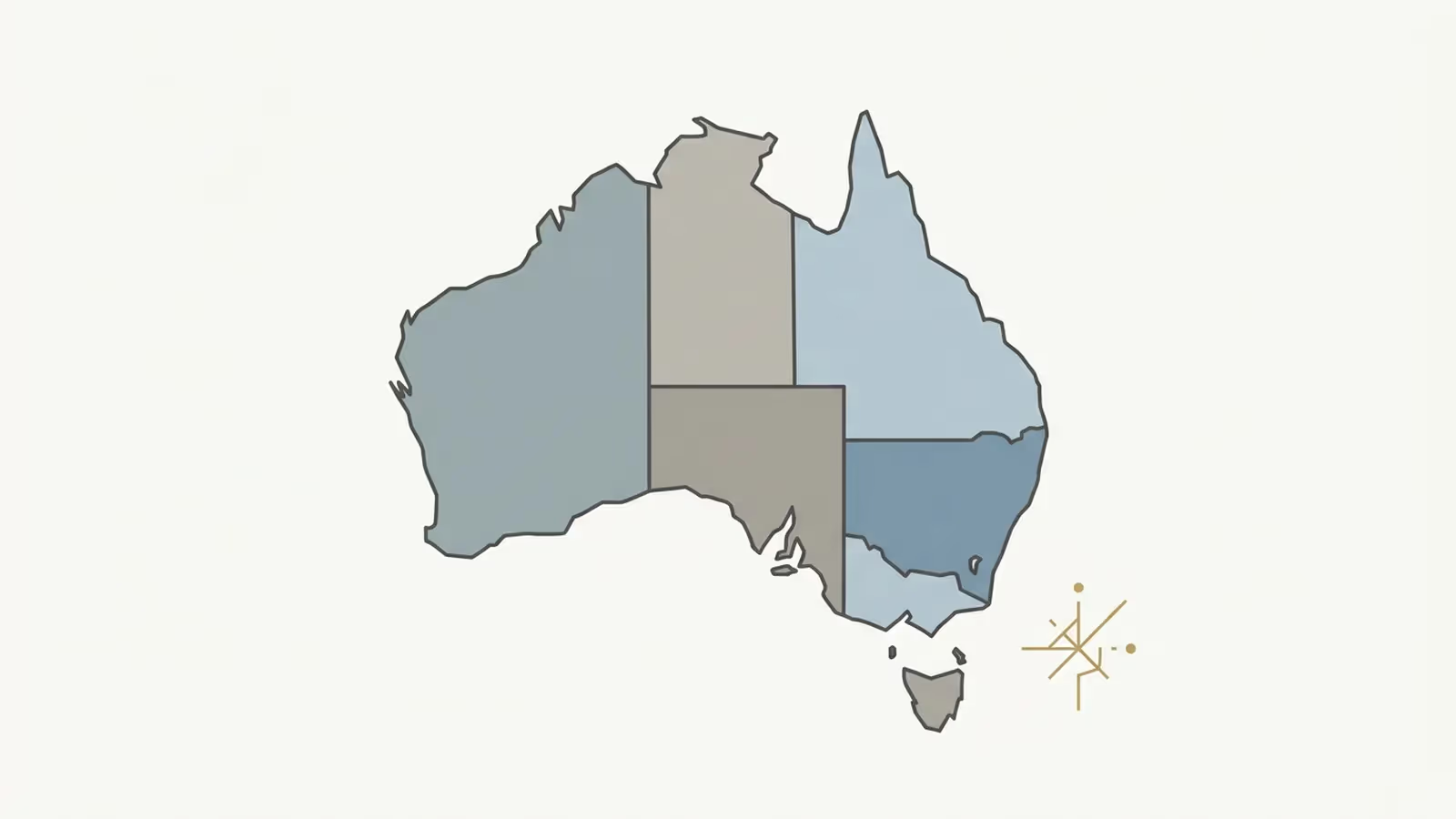
Legal practice in Australia is regulated at state and territory level. The Legal Profession Uniform Law applies in some jurisdictions and not others, and each state and territory has its own regulator — a legal services commissioner, a law society, or both — with its own professional conduct rules.
The practical consequence for a website is that there is no single national answer to what a firm may claim. A statement that is unremarkable for a Queensland firm may not be for a Victorian one. Firms practising across borders are subject to more than one set of expectations on the same page.
Three areas where this bites hardest:
Specialist accreditation is a regulated status. Most state law societies run accreditation schemes, and “accredited specialist” describes a defined credential rather than a marketing adjective. Describing a practitioner as a specialist in an area where they hold no accreditation is a professional conduct question, not a wording preference.
Superiority and outcome claims. Best, leading, top-ranked, highest success rate. These attract the Australian Consumer Law like any other business claim, and the conduct rules on top of it. Publishing settlement figures or success rates raises substantiation questions immediately.
Costs disclosure. Obligations about disclosing legal costs to clients are set out in the applicable professional legislation, and what appears on a website interacts with them. A page implying a fixed price for work that will in fact be charged otherwise is a problem before the first conference.
Personal injury advertising is the most tightly controlled category, and the restrictions differ markedly between jurisdictions — in some, on the content and placement of advertising specifically. A firm doing that work should be taking advice on its website copy rather than adapting another firm’s.
None of the above is legal advice, and a firm should check its own regulator’s current guidance and its professional indemnity insurer’s position.
Trust and qualification for solicitors and lawyers, not volume

For most firms, the website is not the top of a funnel. Clients arrive through referral — from a previous client, another professional, an accountant, a broker, another firm. The website is where they check that the referral was sound.
That reframes almost everything. The measure is not enquiry count. It is whether a person who arrived already half-persuaded leaves persuaded, and whether the wrong enquiries are filtered out before they consume time.
Practically, it means the site should make it easy to establish the firm’s areas of work and the seniority and background of the people who would handle the matter. It should also make clear how the firm charges, and what happens next. It also means qualifying language is an asset rather than a leak: a page that says plainly what the firm does not do saves everyone a conversation.
Practice areas are the structural core
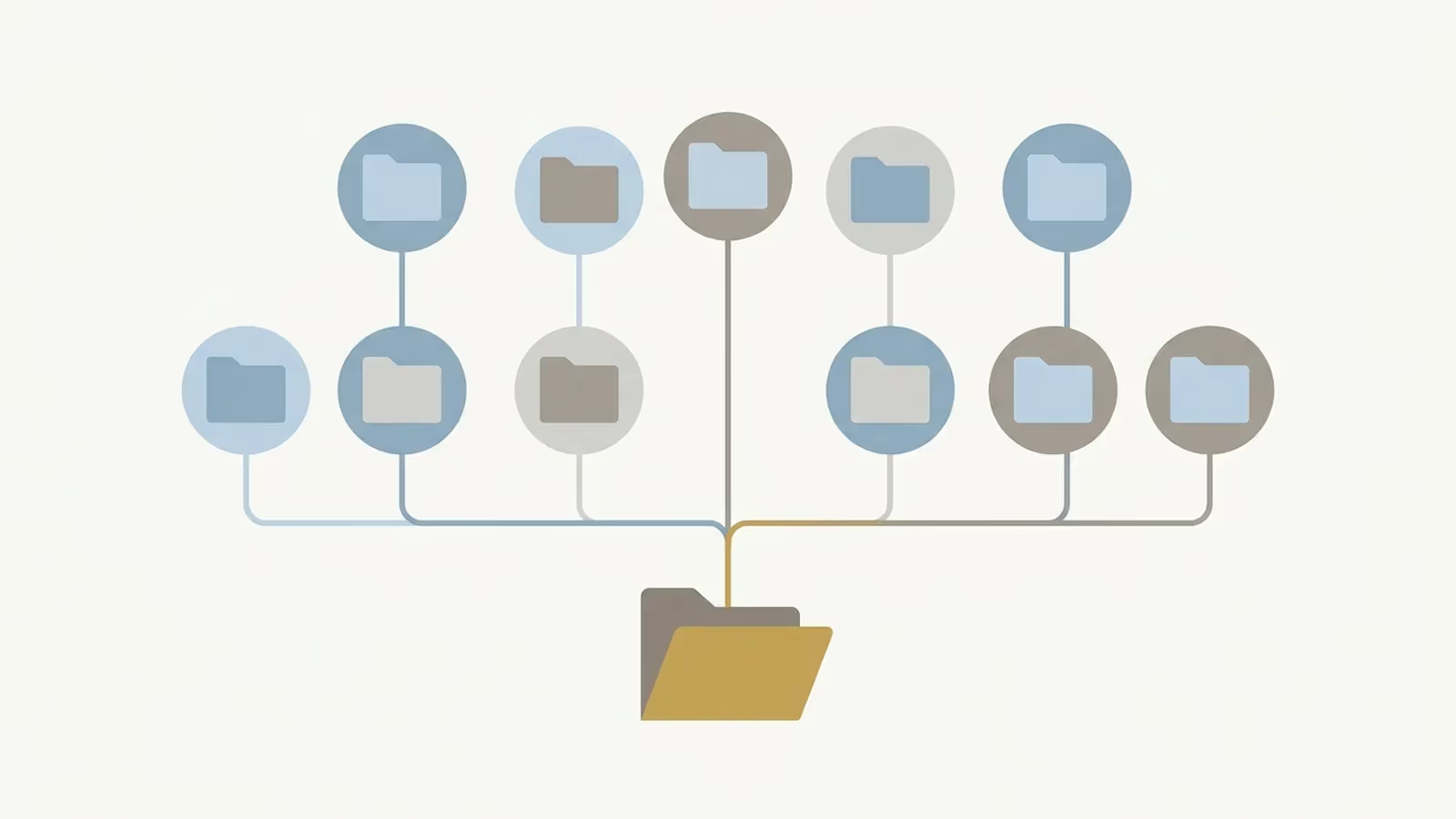
Practice-area pages are where the substance lives, and they are the pages that can be found by someone searching for their problem rather than for a firm.
Scoping them well means resisting two temptations. The first is a page for every conceivable service, which produces thin pages nobody can rank and a site that claims a breadth the firm cannot staff. The second is one enormous page covering everything, which serves nobody searching for a specific issue.
The workable version is one page per area the firm genuinely wants more of, written to answer the question the reader actually has. What is the process, how long does it take, and what does it depend on. What are the likely costs and how are they calculated, what should I do now, and what do I need to bring. Each page should be honest that outcomes depend on circumstances, which is both accurate and the correct compliance posture.
This is also where law firm web design and SEO genuinely overlap, rather than competing for the same budget. Good SEO for a law firm website is mostly good practice-area design done properly: one clear page per area, answering the actual question. It is not SEO treated as a separate layer bolted onto generic web design after the fact. A firm buying web design and a firm buying SEO from different suppliers, working from different page structures, is buying two products that should have been one.
Consumer and commercial legal work needs different law firm website design
This is the most consequential structural decision and it is made badly more often than not.
Consumer legal work — family, wills and estates, personal injury, conveyancing, criminal — reaches people in difficulty who are often unfamiliar with legal process and choosing under stress. The site needs plain language, an explanation of what happens first, clarity on cost, and an approachable tone. Reassurance is doing real work here.
Commercial legal work — corporate, property, employment, disputes — reaches an in-house counsel, a director or a finance officer who is qualifying the firm on capability and depth. They want practitioner backgrounds, transaction experience described at the appropriate level of abstraction, sector familiarity and evidence the firm operates at their scale.
A firm doing both needs the two paths separated from the home page down. Attempting one voice for both produces a site that reads as too commercial for a grieving family and too soft for a procurement officer.
Practitioner profiles for a lawyer or law firm
Profiles carry more weight on a legal site than on almost any other kind. They should state the practitioner’s name, admission date and the jurisdiction of admission, and qualifications with the awarding institution. They should also state areas of practice, any accredited specialisation with the scheme named, professional memberships, and languages spoken.
Photographs should be real and current. A profile that is three roles out of date is a common and avoidable credibility problem.
Confidentiality, and what a contact form must not ask

This is the section most legal websites get wrong, and it is the one with real consequences.
A general contact form should not invite a description of the matter. Two reasons, and both are serious. Unsolicited detail about a dispute can create a conflict problem before the firm has run a conflict check. In the worst case, that means receiving confidential information about a matter where the firm already acts for the other side. And a prospective client sending sensitive detail through a web form may believe a relationship exists when it does not.
The safer pattern is a short form collecting name, contact details, general area of law and preferred contact time. Add a clear statement on the form that the firm cannot advise until a conflict check is completed and a retainer agreed, and that information sent through the form is not confidential and does not create a solicitor-client relationship. That wording should be settled by the firm and its insurer, not adapted from a template.
The intake process behind the form matters as much: who reads it, how quickly, and what the conflict-check step is.
Content marketing, and why generic legal blogging fails
Most law firm blogs fail, and the reason is consistent. They publish general summaries of legislation that a dozen other firms have already published, written for other lawyers rather than for clients, on a schedule nobody sustains.
The version that works is narrower and less frequent: writing about the specific questions clients actually ask, in the language they ask them, from the position of someone who deals with the issue routinely. That content is harder to produce and cannot be replicated by a competitor, which is exactly why it works.
An abandoned blog is worse than none. A page dated three years ago is visible evidence that the site is not maintained.
Accessibility and plain language
The Disability Discrimination Act 1992 (Cth) applies to the provision of services and contains no small-business turnover exemption. For a firm doing consumer work, plain language and accessibility overlap heavily. That means semantic headings, keyboard operation with visible focus, and adequate contrast. It also means labelled form fields, meaningful alternative text, and prose written for a reader who has never met the terminology.
For what the work costs and how to compare quotes with GST stated, see how a website quote is built up. Ownership and contract questions are on who owns your website.
Evidence for this page
This page exists because the demand below was measured, not assumed. The figures are search-market data about the topic — they are not prices.
- Entity this page targets
- law firm web design
- Measured Google volume
- 320 searches/month, Australia
- Keyword difficulty
- 0 of 100
- Advertiser cost per click
- 15.06 AUD CPC
- AI assistant volume
- no data
- Advertiser competition
- LOW (index 5 of 100)
- Measured on
- 3 August 2026
- Search results inspected for intent
- Yes — research/serp-verticals.json — pulled for this page's OWN canonical target "law firm web design" and classified result by result.
3 other phrasings resolve to this same page
law firm website design · web design for law firms · legal website design
"law firm websites" measures only 90 a month but at difficulty 50 against this entity's difficulty 0 — the smaller phrase scoring as far harder across largely the same pages. That is the third independent contradiction the difficulty model has produced on this site, after Brisbane (10/23/43/50 on one entity) and tradie (8 against 40). It is a caution about the metric, not a finding about the market.
Source: research/vertical-phrasings-au.json + research/cpc-competition-au.json + research/serp-verticals.json · DataForSEO Labs and SERP classification, location_code 2036 (Australia), language en · pulled 3 August 2026.
Provenance
Written by Australian Website Design. Published 2026-08-03, last updated 2026-08-03.
Sources
- Industry keyword volume and difficulty, Australia —
research/vertical-phrasings-au.json(accessed 2026-07-31) - Advertiser cost-per-click and competition, Australia —
research/cpc-competition-au.json(accessed 2026-07-31) - Search result classification for industry terms —
research/serp-verticals.json(accessed 2026-07-31) - Law Society of NSW — advertising legal services (accessed 2026-08-04)
- Queensland Law Society — advertising rules for personal injury work (accessed 2026-08-04)