Industries
NDIS web design: what a provider's website has to do
NDIS web design: three audiences read a provider site differently. Accessibility, plain language, registration clarity, and privacy on the enquiry form.
In short. A provider website is read by participants, by families and carers, and by support coordinators, and those three readings pull the structure in three directions. Accessibility here is not a compliance chore — it decides whether the audience can use the site at all.
An NDIS provider’s website is read by at least three different people, and they want incompatible things from it. A participant wants to know whether the service suits them and whether they will be treated with respect. A family member or carer wants to know whether the organisation is safe, competent and contactable. A support coordinator, who may be shortlisting six providers before lunch, wants registration groups, service areas, capacity and a referral pathway, and wants them in under a minute.
Most provider sites are built for the first reader and only the first reader. That is why coordinators end up ringing to ask questions the website should have answered.
This page describes what a provider website has to do in Australia, from knowledge of how the sector operates and how the audiences differ. It is general information, not legal or compliance advice. No client work in this sector is claimed anywhere on it — there are no case studies, provider names or results here.
What the measurement says about NDIS web design, and what was declined
Measured for Australia on 31 July 2026 in research/vertical-phrasings-au.json and research/cpc-competition-au.json, “ndis web design” draws about 390 searches a month at keyword difficulty 7. Advertisers pay 18.58 AUD CPC into a LOW competition band at index 11. The results were classified the same day in research/serp-verticals.json: nine of nine agency pages. Real commercial demand, softly contested.
A larger phrase exists and is not targeted here, and the reasoning is worth showing.
“ndis websites” measures 1,900 searches a month — nearly five times bigger. It would be an easy number to put in a headline. Two things made it suspect before anything was checked: difficulty 53 against 7, and an advertiser valuation of 6.78 AUD CPC against 18.58. A click worth roughly a third as much, at five times the volume, usually means the searchers are not buyers.
It was checked on 3 August 2026 and recorded in research/serp-siblings.json. Of seven results, three are agencies. Position one is ndis.gov.au. Position four is the NDIS Quality and Safeguards Commission. Position seven is the National Disability Services peak body. Position three is a round-up listicle. Most of that volume is people looking for the NDIS itself, or for the regulator, and only a minority are looking for a web designer.
So it is declined, permanently, and the number is not claimed anywhere on this site. The advertiser valuation was the tell and it was correct.
Three audiences for an NDIS provider website, one site

This is the structural fact everything else follows from.
Participants read for fit and for tone. Can this service help with my situation, is it available where I live, will I be spoken to as an adult. Language matters more here than anywhere else on a provider site: material written about people rather than to them is noticed immediately.
Families and carers read for safety and competence. Who are the staff, what checks do they hold, what happens when something goes wrong, how do I raise a concern, and is there a person I can actually speak to.
Support coordinators and local area coordinators read like professionals doing triage. Registration groups, service categories, geographic coverage, current capacity, waitlist position, referral process, and whether a referral form exists that does not require a phone call first.
Serving all three from one home page produces a page that serves none. The workable pattern is a home page that routes rather than explains, with a clearly signposted path for each reader. Add a referral or capacity page that a coordinator can be sent straight to.
Accessibility for participants with disability is functional here, not a compliance chore
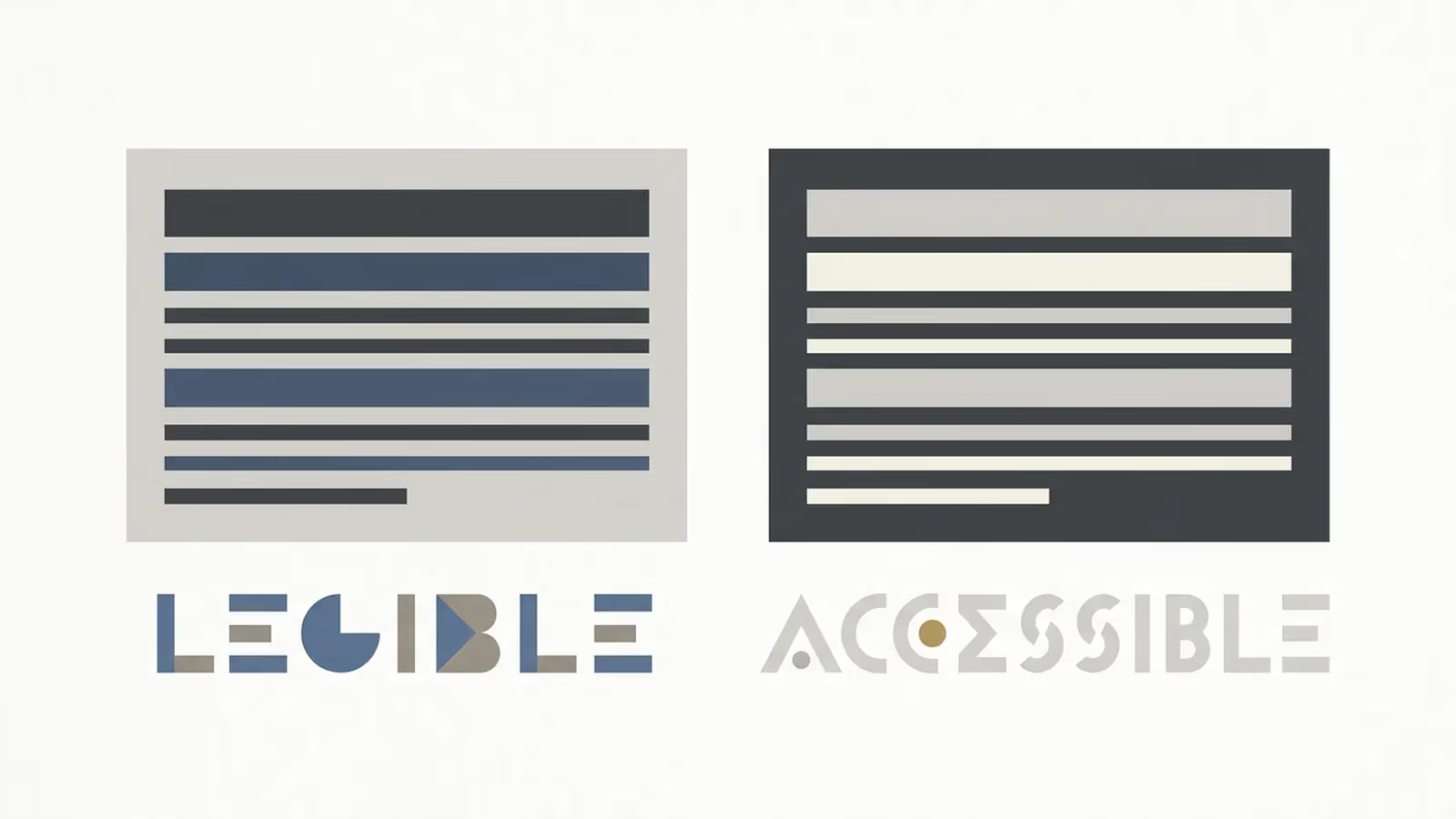
On most websites accessibility is an obligation. On a disability services website it is the product working or not working.
The audience includes people with vision impairment using screen readers or heavy magnification, and people with motor impairment using keyboard-only navigation or switch devices. It also includes people with cognitive disability, for whom dense text is a barrier, and people with hearing impairment, for whom uncaptioned video carries no information. A provider site that fails these people has failed in the specific way that most undermines what the organisation says about itself.
The obligation exists independently. The Disability Discrimination Act 1992 (Cth) makes discrimination unlawful in the provision of goods, services and facilities, and unlike the Privacy Act it contains no small-business turnover exemption. The Web Content Accessibility Guidelines are the technical standard generally used to demonstrate whether the obligation has been met, and Level AA is the level Australian policy material points to. None of that is legal advice, and how it applies to a particular provider is a question for advice.
The practical shortlist is unglamorous: semantic headings in a logical order, full keyboard operation with visible focus, sufficient contrast, and meaningful alternative text. It also means labelled form fields with errors described in text rather than by colour, captions on video, and no content that depends on a hover. Automated scanners detect only a minority of the criteria — commonly estimated at a third to a half. So a green result from a tool is not a finding of conformance.
Plain language, and what it is not

Plain language is not simplified language, and it is not writing down to people. It is short sentences, common words, one idea at a time, active voice, and the answer before the explanation.
Two specific habits matter in this sector. Expand acronyms on first use, including ones that feel universal internally. And avoid the funding-model vocabulary — plan-managed, self-managed, agency-managed, core supports, capacity building — without a plain-English gloss. A new participant may not have learned it yet, and a page that assumes they have is a page that excludes them.
Easy Read versions of key pages are worth considering. They are a distinct discipline with their own conventions rather than a shortened version of the main text.
Registration groups and service categories for NDIS providers, stated clearly

A coordinator matching a participant to a provider is matching against a defined list. If a site describes its services only in warm prose, it cannot be matched, and it will be passed over in favour of a provider whose page can be scanned.
State the registration status, the registration groups and service categories covered, the geographic areas actually serviced, and the current capacity or waitlist position. Capacity is the one most often omitted. It follows from how the role works that capacity will be among the first things asked. A coordinator with a participant to place cannot use a provider that has no room, however good the fit. That is an inference from the sector’s structure, not something observed here.
Registration status has to be stated accurately, and providers should describe their status as it is rather than as it reads best. Registered and unregistered providers operate under different arrangements, and misdescribing that is not a marketing error — holding out as a registered provider when you are not is capable of being a breach of the NDIS Code of Conduct in itself, independently of anything else on the site.
Advertising, conduct and what an NDIS provider may claim
The NDIS Quality and Safeguards Commission regulates provider conduct, including through the NDIS Code of Conduct, and its expectations reach into how services are described to participants. The Australian Consumer Law applies as well, as it does to any service marketed in Australia.
Three practical consequences for a website:
Outcome claims are a risk area. Statements that a service will produce a particular result for a participant are difficult to substantiate and can mislead a person making a significant decision under pressure.
Testimonials need care. Publishing participant experiences raises consent, privacy and dignity questions before it raises compliance ones. A participant’s capacity to consent to public identification is a genuine consideration, not a formality. Providers should take advice on their own circumstances rather than copying what another provider does.
Comparative and superiority claims — safest, largest, best — carry the same substantiation burden here as anywhere, in a sector where the reader may be poorly placed to test them.
The honest position is that the boundary is not always obvious, it is not identical for registered and unregistered providers, and it is a question for the Commission’s own guidance and for advice, not for a web page.
Privacy, and the enquiry form

An NDIS enquiry form will attract information about a person’s disability, which is health information and therefore sensitive information under the Privacy Act 1988 (Cth), attracting stronger protections than an ordinary name and email.
Two practical consequences. Collect the minimum needed to make contact and no more. A form asking for diagnosis, NDIS number or plan details before anyone has spoken is collecting sensitive information it does not yet need. And know where the submission goes. An enquiry processed or stored overseas is a cross-border disclosure with obligations attached, and the small-business exemption many operators currently rely on is under active reform. Its removal was agreed in principle in the Government’s response to the Privacy Act Review, but no second-tranche Bill has been introduced and no commencement date is legislated as at 3 August 2026. Dates circulating in industry commentary are not attached to any tabled or passed instrument, so none is repeated here. It is a change to watch rather than a date to plan against.
Say plainly on the form what will be collected, who will see it, and how quickly someone will respond.
How support coordinators and support coordination actually shortlist NDIS providers
Referral pathways are the part most provider sites treat as an afterthought.
A coordinator with a participant to place will typically check capacity, service area and registration groups. Then they look for the fastest way to make contact with a named person. What helps: a referral page addressed to coordinators specifically, and a structured referral form that captures what the provider needs. It also means a named intake contact with a direct email and phone number, rather than a general enquiry address. Add a stated response time and a downloadable service description they can send to a participant.
What does not help: a single contact form for participants, families, coordinators and job applicants.
The practical shortlist for NDIS websites, website design and care
Registration status, groups and categories. Service areas. Current capacity or waitlist. What each service actually involves, in plain language. Who the staff are and what checks they hold. How to make a referral, with a named contact. How to give feedback or make a complaint, including the pathway to the Commission — a provider that publishes its complaints process is making a credibility statement, not admitting a weakness. Accessibility done properly. A privacy statement that describes the form accurately.
For what the work costs and how to compare quotes with GST treatment stated, see why two quotes for the same site differ. The accessibility obligations in more detail are on website accessibility in Australia.
Evidence for this page
This page exists because the demand below was measured, not assumed. The figures are search-market data about the topic — they are not prices.
- Entity this page targets
- ndis web design
- Measured Google volume
- 390 searches/month, Australia
- Keyword difficulty
- 7 of 100
- Advertiser cost per click
- 18.58 AUD CPC
- AI assistant volume
- no data
- Advertiser competition
- LOW (index 11 of 100)
- Measured on
- 3 August 2026
- Search results inspected for intent
- Yes — research/serp-verticals.json — pulled for this page's OWN canonical target "ndis web design" and classified result by result.
3 other phrasings resolve to this same page
ndis website design · web design for ndis providers · ndis provider website design
"ndis websites" measures 1,900 a month — nearly five times this entity — at difficulty 53, 6.78 AUD CPC and competition index 8. It was checked on 3 August 2026 and DECLINED (research/serp-siblings.json). Only 3 of 7 results are agencies: position 1 is ndis.gov.au, position 4 is ndiscommission.gov.au, position 7 is the National Disability Services peak body, and position 3 is a listicle. The low advertiser valuation was the tell and it was right — most of that volume is people looking for the NDIS itself, not for a web designer. No page targets it and the number is not claimed anywhere on this site.
Source: research/vertical-phrasings-au.json + research/cpc-competition-au.json + research/serp-verticals.json · DataForSEO Labs and SERP classification, location_code 2036 (Australia), language en · pulled 3 August 2026.
Provenance
Written by Australian Website Design. Published 2026-08-03, last updated 2026-08-03.
Sources
- Industry keyword volume and difficulty, Australia —
research/vertical-phrasings-au.json(accessed 2026-07-31) - Advertiser cost-per-click and competition, Australia —
research/cpc-competition-au.json(accessed 2026-07-31) - Search result classification for industry terms —
research/serp-verticals.json(accessed 2026-07-31) - NDIS Quality and Safeguards Commission (accessed 2026-08-03)
- Disability Discrimination Act 1992 (Cth) (accessed 2026-08-03)
- Search result classification for declined sibling terms —
research/serp-siblings.json(accessed 2026-08-03)