Pricing
Website design packages, and what they leave out
Website design packages in Australia — what gets removed to reach a package figure, what to check before buying, and how to compare two that look identical.
In short. A package reaches its figure by removing work. Knowing which work was removed is the whole skill of buying one. Ask for the exclusions in writing, count unique layouts rather than pages, and compare packages on a three-year total including GST rather than on the headline.
A website design package is a website sold as a fixed bundle: a set number of pages, a set list of inclusions, one figure. Web design packages are popular for a reason that has nothing to do with marketing. They make an unfamiliar purchase legible. Instead of an open-ended conversation about scope, you get a table with three columns and a decision you can actually make.
Australians look for them in real numbers. Measured on 31 July 2026 and recorded in research/national-volume-au.json, “website design packages” draws 480 searches a month at a keyword difficulty of 0, with the alias “web design packages” adding 320. Difficulty 0 means essentially nobody has bothered to compete for the term properly, which is a reasonable summary of how carefully most package pages are written.
This page is about what a package actually is underneath the table, and how to compare two of them that look identical.
Why website design packages exist
Packages solve three problems, and only one of them is yours.
For you, a package removes the fear of an open-ended bill. You know what leaves your account and roughly what arrives.
For the supplier, a package does two other things. It caps scope, which is the single largest risk in any web project — a fixed price with an undefined scope is how agencies go broke. And it makes the work repeatable, which lowers the cost of producing it. A supplier who has built the same shape of site forty times has a build path, a checklist and a set of reusable parts. That efficiency is real, and some of it is genuinely passed on.
None of that is cynical. A well-drawn package is an honest trade: you accept constraints, and in exchange you get a lower figure and a shorter timeline than a bespoke process would produce. The trouble starts when the constraints are not written down.
What gets cut to hit a package figure
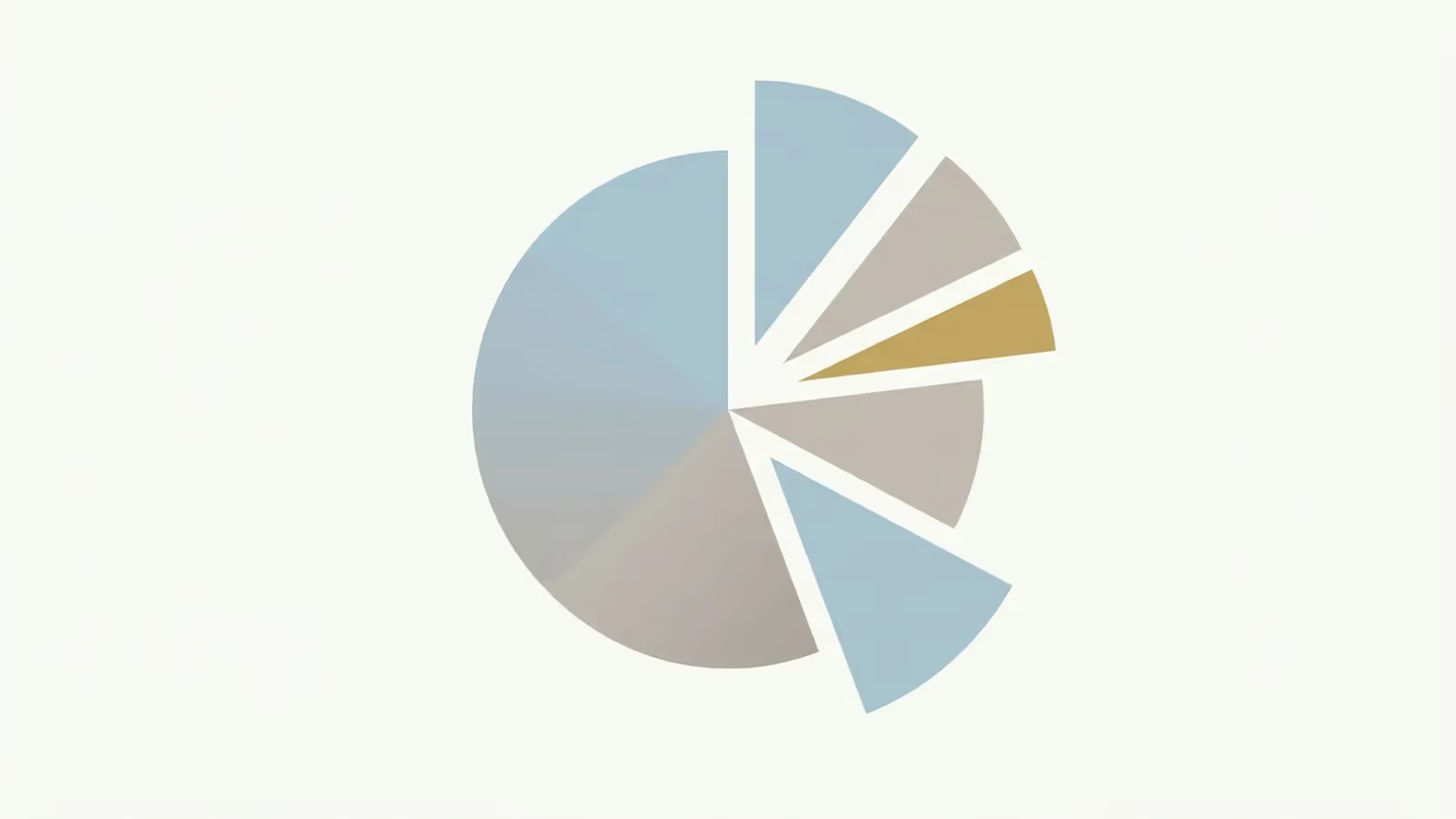
A package figure is reached by removing work. That is the mechanism. Knowing which work was removed is the whole skill of buying one.
Content writing is the most commonly removed item
The most commonly removed item, and the most consequential. Packages routinely include the pages but not the words in them. If nobody says otherwise, assume you are writing the copy, and be honest with yourself about whether you will.
Photography of your actual premises and team
Stock imagery is usually included. Photographs of your premises, your team and your actual work are usually not, and they are the difference between a site that looks like you and a site that looks like a template with your logo on it.
Revision rounds beyond the first one or two
Bespoke work absorbs changes. Packages cap them, often at one or two rounds, with anything further billed by the hour. This is reasonable and it is also where package projects most often exceed their headline figure.
| What it is | Typical | Range | Projects |
|---|---|---|---|
| Hourly rate for ad-hoc work | Withheld — not yet reviewed | ||
Figures not published. The pricing dataset has not been reviewed and released, so no figure is shown here. The site is built to refuse to render prices in this state rather than show a provisional number. What is published and what is not.
Why every figure on this page is withheld (6 reasons)
- dataset status is "PLACEHOLDER_UNREVIEWED", not "VERIFIED"
- dataset publishable is false, not true
- GST treatment has not been stated — ACL s48 requires it explicitly, at equal prominence
- the dataset has not been dated — undated figures are not citable
- the collection method has not been written down — an unsourced figure is an assertion
- no band passes the band-level audit
Unique layouts, as distinct from page count
A ten-page package rarely means ten designed pages. It usually means two or three layouts, repeated. That is fine, and it is often the right answer, but it should be stated.
Strategy work behind the standard structure
Deciding what the site should say, who it is for, and how the pages should be ordered is work. In a package it is usually replaced with a standard structure. Sometimes the standard structure is exactly right for you. Sometimes it is a plumber’s site with a dentist’s words in it.
Search, Google visibility and accessibility work
“SEO included” in a package generally means the technical basics are not broken: pages have titles, headings are in order, the site is not blocking Google and other search engines. It rarely means research, content built for demand, or ongoing work. Accessibility is often not mentioned at all. That matters, because accessibility obligations attach to the business operating the site, not to whoever built it.
Everything after launch: hosting and support
Some packages include a support period. Some include hosting for a year, after which the renewal arrives at a figure nobody discussed. Some include nothing and do not say so. This is set out in full on what upkeep actually costs.
What to check before you buy a package: GST first
Work through these before signing. Each is a plain question with a plain answer, and a supplier who has drawn their package carefully will answer all of them without hesitation.
- Is the figure inclusive or exclusive of GST. Package tables are the worst offenders for this. Across the nine Australian cost pages checked on 31 July 2026 and recorded in
research/pricing-bands.json, none stated GST treatment at all. - How many unique page designs, as distinct from how many pages.
- Who writes the copy. If it is you, ask what happens to the timeline and the price if your words are late.
- How many revision rounds, and the rate for further ones.
- What is explicitly excluded. A package that lists only inclusions is telling you half a story. Ask for the exclusions in writing.
- What the ongoing costs are and when they start. Hosting, domain, licences for any commercial themes or plugins, and any third-party service the site depends on.
- Who owns the result. Design files, code, content, domain, hosting account. Ownership is set by the contract.
- Can the site be moved. If the package is built on a platform you cannot export from — a closed website builder rather than something like WordPress — the price of leaving is a rebuild, and that is a cost of the package even though it appears nowhere in the table.
- What happens if it is not delivered. Deposit terms, milestones, and what is recoverable.
How to compare two website packages that look the same
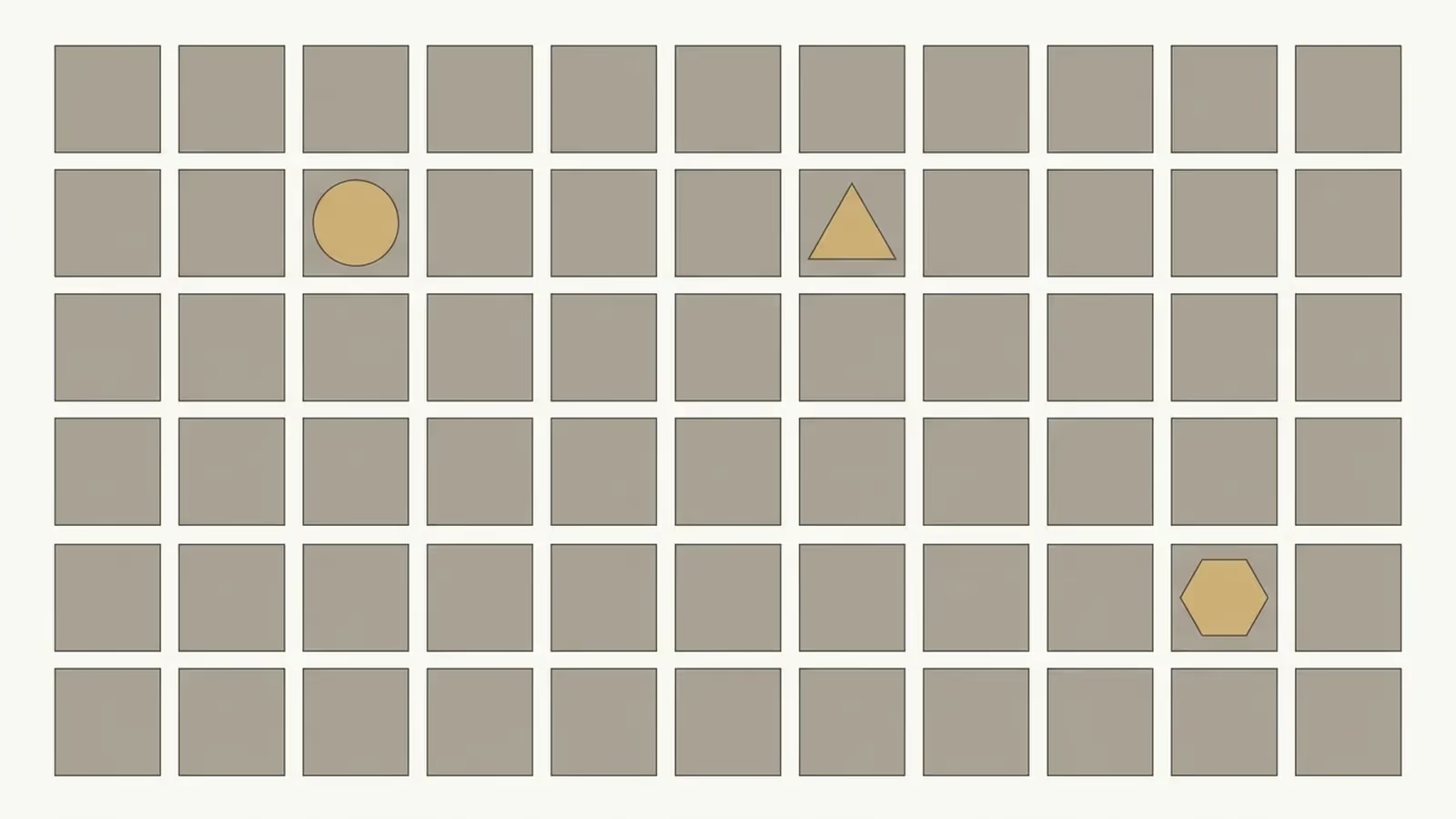
Two package tables with the same page count and a similar figure can represent very different amounts of work. Here is how to separate them.
Convert both to a total payable including GST over three years
Not the build figure. Build, plus hosting, plus domain, plus any licence fees, plus maintenance, plus a realistic allowance for changes, across three years. Packages that look close at the headline routinely separate by a wide margin once the ongoing side is included. Three years is roughly the useful life of a small business site before it wants refreshing.
Count unique layouts, not pages
Ask each supplier directly.
Ask each what is excluded
The differences between two packages live in the exclusions, never in the inclusions. This one question separates them faster than anything else.
Ask who writes the words
If one package includes copywriting and the other does not, they are not comparable at any figure, because the excluded one carries a cost that has simply been moved onto you or onto a writer you will hire later.
Ask what happens in month thirteen
Introductory hosting or support periods that lapse quietly are the most common source of an unwelcome renewal.
Check whether the package can grow
If you add a service line next year, is that a new page inside the existing structure or a rebuild. Cheap now, rebuild in eighteen months is a real pattern and it is not always visible at purchase.
Common questions about website design packages
What usually gets cut to reach a package figure? Content writing, photography of the actual business, revision rounds beyond one or two, unique page layouts, strategy work, and anything that happens after launch. A package that lists only inclusions is telling you half the story; ask for the exclusions in writing.
How do I compare two packages that look the same? Convert both to a total payable including GST over three years, counting hosting, domain, licences, maintenance and a realistic allowance for changes. Then count unique layouts rather than pages, and ask each supplier what is excluded. The differences between two packages live in the exclusions.
When a package is the right answer
Often. A package suits you when your requirements are genuinely ordinary: you need to be found, to be understood, and to be contacted. Most small Australian businesses are in exactly that position, and paying for a bespoke process to arrive at a structure that a competent package already encodes is money spent on ceremony.
A package stops being the right answer when you need the site to do something specific to how your business actually runs. At that point the package will be extended with variations, and the variations will be billed at the hourly rate. The total will exceed what a properly scoped build would have cost — arriving there by a longer and more frustrating route.
The honest test is this: read the package’s standard page structure and ask whether it describes your business. If it does, take the efficiency. If you find yourself planning workarounds before you have even started, you have outgrown it. When that happens, what moves the figure in a quote sets out how a scoped build is priced instead.
| What it is | Typical | Range | Projects |
|---|---|---|---|
| Small business brochure site | Withheld — not yet reviewed | ||
Figures not published. The pricing dataset has not been reviewed and released, so no figure is shown here. The site is built to refuse to render prices in this state rather than show a provisional number. What is published and what is not.
Why every figure on this page is withheld (6 reasons)
- dataset status is "PLACEHOLDER_UNREVIEWED", not "VERIFIED"
- dataset publishable is false, not true
- GST treatment has not been stated — ACL s48 requires it explicitly, at equal prominence
- the dataset has not been dated — undated figures are not citable
- the collection method has not been written down — an unsourced figure is an assertion
- no band passes the band-level audit
The figures for each band are withheld until the underlying dataset is reviewed and released. The reasons are itemised in how the bands were assembled. The questions above work without them, which is most of the point. A package is judged on its exclusions and its ongoing costs, and both of those are things you can establish today with a phone call.
If the business is small enough that most of a standard package would go unused, packages scoped for a small business covers what you actually need.
Evidence for this page
This page exists because the demand below was measured, not assumed. The figures are search-market data about the topic — they are not prices.
- Entity this page targets
- website design packages
- Measured Google volume
- 480 searches/month, Australia
- Keyword difficulty
- 0 of 100
- Advertiser cost per click
- 7.63 AUD CPC
- AI assistant volume
- 2 prompts/month
- Advertiser competition
- LOW (index 18 of 100)
- Measured on
- 31 July 2026
- Search results inspected for intent
- Yes — research/serp-commercial.json — pulled 3 August 2026 for this page's OWN canonical target "website design packages" and classified by hand, title by title. 8 of 9 agency package pages.
5 other phrasings resolve to this same page
web design packages · website development packages · custom website design packages · affordable website design packages · affordable website design
"web design packages" measures 320 a month separately, at the same difficulty of 0. It is the same commercial question in different words and resolves to this page rather than a second one. Difficulty 0 across the whole cluster means essentially nobody has competed for it properly.
Source: research/national-volume-au.json + research/cpc-competition-au.json · DataForSEO Labs, location_code 2036 (Australia), language en · pulled 31 July 2026.
Provenance
Written by Australian Website Design. Published 2026-07-31, last updated 2026-07-31.
Sources
- National keyword volume and difficulty, Australia —
research/national-volume-au.json(accessed 2026-07-31) - Advertiser cost-per-click and competition, Australia —
research/cpc-competition-au.json(accessed 2026-07-31) - Audit of nine Australian competitor cost pages —
research/pricing-bands.json(accessed 2026-07-31)