Services
What a small business website actually needs
Small business website design in Australia: the work itself, not the package price. How to scope a site from demand, not a capability list.
In short. Scope from demand, not from your capability list: one page per service you want the phone to ring about. Supplying your own words, photographs and business details in one go at the start is the largest lever you have on both the quote and the timeline.
A small business buying a website is buying about six things at once, and the quote usually names one of them. There is the structure, the words, the pictures, the code, the arrangement that keeps it online, and the set of decisions about who the site is talking to. The last one is invisible on an invoice and it determines whether the other five were worth paying for.
Measured for Australia on 31 July 2026, “small business website design” draws 720 searches a month at a keyword difficulty of 22. Competition is recorded as LOW at an index of 24, with advertisers paying 18.86 AUD CPC — recorded in research/national-volume-au.json and research/cpc-competition-au.json. research/ai-vol-keywords.json records 23 prompts a month to AI assistants for the same phrase. The advertising figure is the interesting one. It shows what a single visit from someone in your position is worth to the people selling these builds — a reasonable reason to arrive at the conversation prepared.
This page is about the work and how to scope it. If what you want is how a fixed bundle reaches its figure, packages scoped for a small business covers that instead.
What a small business website is actually buying
Not files. Files are the by-product. What you are buying is a working asset. A stranger can find it, read it and act on it without your help. And you can still change it in two years, once your business has moved on.
That asset has four parts worth naming, because they are the parts that get quoted vaguely.
A structure. The decision about which pages exist, what each is for, and how somebody moves between them. This is the cheapest thing to get right at the start and the most expensive to change afterwards.
A set of pages that answer something. Not pages that describe you. Pages that answer the question a person had when they went looking.
A build. The code, the templates, the forms, the settings, and the speed at which it all loads on a phone with an ordinary connection. Most small business sites now run on a cloud-based CMS rather than custom-built software, which is worth knowing when you compare quotes.
An arrangement for afterwards. Hosting, the domain, updates, backups, and a named person who does them.
The difference between a site that exists and a professional website design that produces enquiries
Most small business websites exist. Far fewer produce enquiries, and the gap between the two is not usually design quality. It is these five things.
It matches what the person typed. Someone searching for a specific service in a specific area needs to land on a page about that service in that area, not on a home page that lists eleven services with equal weight.
It says what you do in the first screen, in the customer’s words. Not your industry’s words. If your customers say “blocked drain” and your page says “hydraulic remediation”, the page is not for them.
Contact is one action. A phone number that dials when tapped. A form short enough that a person on a phone will finish it. An address if you have premises, service areas if you travel, and hours that are current.
It loads. A site that takes several seconds on regional mobile data is losing people before it says anything. Every third-party script, chat widget and review carousel is a withdrawal from that account.
It gives a reason to believe you. Photographs of your actual work and premises, real people with real names, licence and registration numbers where your trade requires them, and specifics rather than adjectives.
None of that is a promise about rankings or leads, and anybody offering you one of those is selling something they cannot deliver. It is simply the difference between a site that can convert attention and a site that cannot.
How to scope a small business website
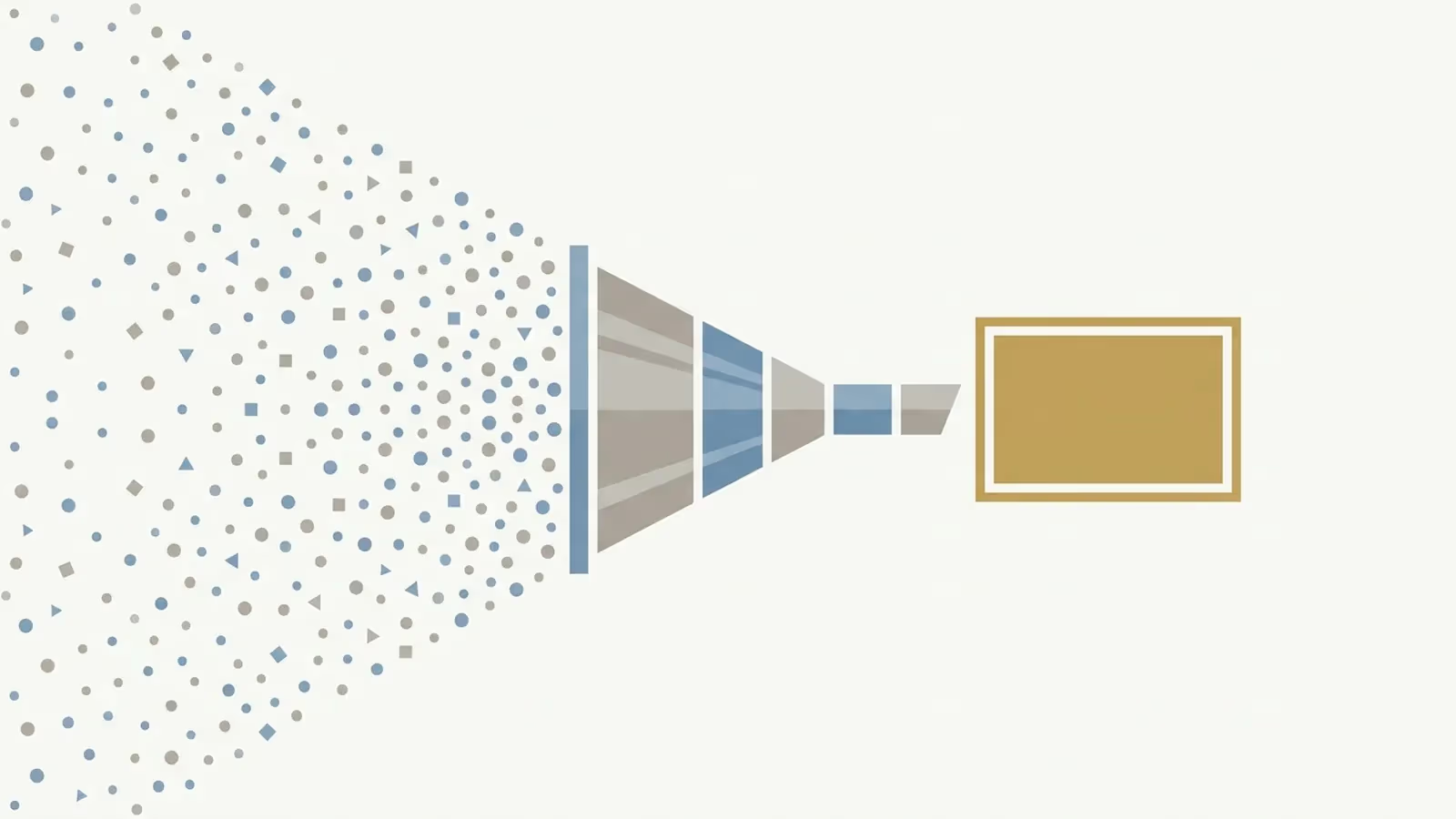
Scope from demand, not from your capability list.
The instinct is to write down everything the business can do and ask for a page for each. That produces a site where the thing you want more of sits at equal weight with the thing you took on twice in 2019 and disliked both times.
The better method is one page per service you want the phone to ring about. Those are the pages worth writing properly, worth photographing, worth linking to, and worth sending advertising to. Everything else can live as a paragraph on a combined page and be promoted later if demand appears.
Do the same with geography. One page per area you genuinely serve differently, with content that is genuinely different: the suburbs covered, the travel arrangements, real jobs done there. Fifteen near-identical pages with the place name swapped read poorly to customers. Search engines understand them well, too — as thin duplication.
The output of scoping should be a numbered list of pages, each with one sentence saying what the page is for and who arrives on it. That list is the thing you send to suppliers. Two quotes written against the same list are comparable. Two quotes written against “we need a website” are not.
What you can supply a web designer or CMS, and in what form
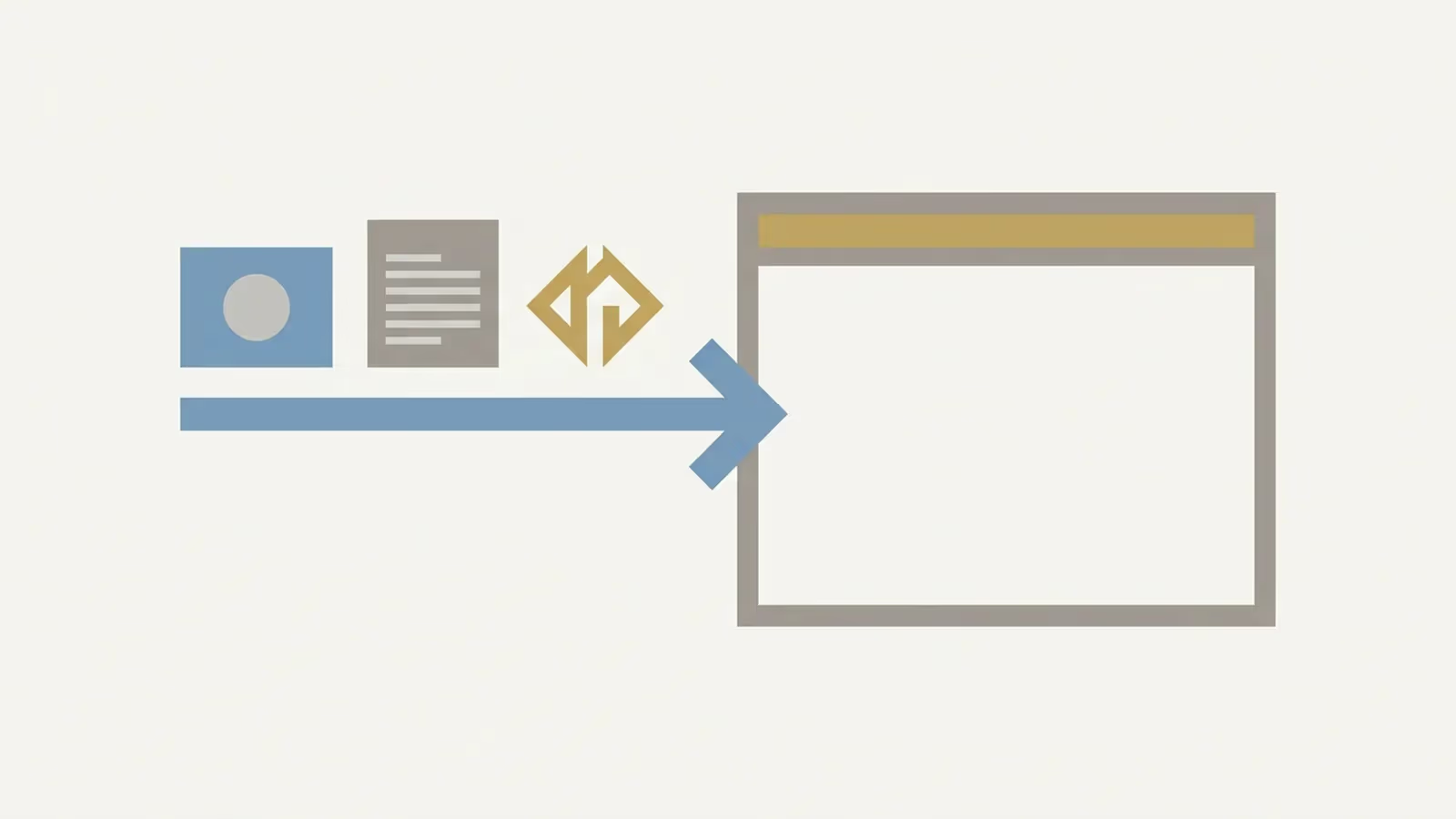
Supplying material yourself lowers the quote and shortens the build. Small business website packages covers why that works on the money side. What matters here is the form it arrives in, because material in the wrong form creates work rather than removing it.
Words: a rough draft per page in a plain document, or voice memos describing each service as you would explain it to a customer on the phone. Both are useful. A folder of old brochures is less useful than it looks.
Photographs: originals at full resolution, straight off the phone or camera, not images already resized for social media. Premises, team, vehicles, tools, and finished work with a note on what each job was.
Logo: the largest or vector version you have, not one lifted from your Facebook page.
Business facts, gathered once, in one document: legal trading name, business registration, licence and registration numbers, insurances, service areas, hours, and the phone number and address written exactly as you want them to appear.
Access: the domain registrar account, any existing hosting, and any analytics or business listing accounts already in existence.
Hand it over in one go at the start. Material dribbling in over six weeks is the most common cause of a build that quietly doubles its timeline.
Ownership, portability, the domain name and shopfront
Decide these before the deposit, because they are set by the contract rather than by custom, and they are the questions that become expensive at exactly the moment the relationship has gone wrong.
- The domain registered in your business name, in an account you control. This is the one item that is genuinely painful to recover, and the one most often held by the supplier.
- The site itself: whether you own the code and design, or hold a licence to use them, and whether that licence survives you leaving.
- The content you supplied, which should remain yours without argument, and the content they wrote, which may not be.
- Stock imagery licences, and whether they transfer to you or remain with the supplier.
- Administrative access at the highest level, not a limited editor account.
- The export path: whether the site can be moved to another host or another supplier, and what actually comes out when you do. If the answer is a rebuild, that rebuild is a cost of this purchase even though it appears nowhere in the quote.
The ongoing obligations nobody mentions at the quote stage

Launch day is when the recurring costs and duties begin, and they attach to you, not to the person who built it.
Hosting and domain renewals, each with GST, each on a date somebody needs to diarise. Software and plugin updates, and licence renewals for any commercial theme or plugin the build depends on. Backups that are actually restorable rather than merely taken. Monitoring that the enquiry form still delivers to an inbox somebody reads — this fails silently more often than anything else on a small site. Privacy obligations that follow from collecting personal information through that form. Accessibility obligations, which sit with the business operating the site regardless of who built it. And keeping the claims on the site accurate, because Australian Consumer Law applies to what your website says about your services long after the developer has been paid.
Ask who does each of these, how often, and what it costs per year including GST. the ongoing cost of running a website sets out the shape of that side.
How to brief it: affordable, professional and CMS-ready
One page, sent to every supplier you approach:
- What the business does, who for, and where.
- The three questions customers ask before they book.
- The numbered page list from your scoping.
- What you will supply and by when.
- Two or three sites you like, described by behaviour rather than adjectives. “The service pages get to the point in two sentences” is useful. “Modern and clean” is not.
- Your deadline and what is driving it.
- Who signs off, and how many people have opinions.
- Your budget range. Withholding it does not get you a lower quote, it gets you a quote for a different project.
What to check before you sign
- Whether the figure is inclusive or exclusive of GST, and the total payable.
- What is explicitly excluded, in writing. The differences between two quotes live in the exclusions.
- How many unique page designs, as distinct from how many pages.
- How many revision rounds, and the rate for further ones.
- What happens to the timeline and the price if your content is late.
- Who owns what at final payment.
- What happens if it is not delivered, and what is recoverable.
- Every ongoing cost with the date it first falls due.
A small business website design brief that names a designer’s actual deliverables, not just a business’s wish list, is what turns website design from a guess into a website a small business can actually run. For how those answers translate into a figure, read why two quotes for the same site differ. If the words are the part you are least sure about, who writes the words covers that as its own piece of work. If the build itself is the part that worries you, the Brisbane build page covers the engineering side.
Evidence for this page
This page exists because the demand below was measured, not assumed. The figures are search-market data about the topic — they are not prices.
- Entity this page targets
- small business website design
- Measured Google volume
- 720 searches/month, Australia
- Keyword difficulty
- 22 of 100
- Advertiser cost per click
- 18.86 AUD CPC
- AI assistant volume
- 23 prompts/month
- Advertiser competition
- LOW (index 24 of 100)
- Measured on
- 31 July 2026
- Search results inspected for intent
- No
3 other phrasings resolve to this same page
small business web design · small business website design australia · website design for small business
DEMOTED FROM MONEY PAGE, 3 August 2026. This page carried isMoneyPage: true while its SERP check had FAILED at 3 of 7 — a result page of DIY site builders, how-to guides and business.gov.au. A money page is one enquiries are routed to on demonstrated commercial demand, and this entity has demonstrated the opposite. The demotion also lifts the in-degree floor, which was forcing internal links toward a page known not to convert. The packages phrasing of this entity (320/month at difficulty 4) is a separate page at /pricing/small-business-packages, which is about how a fixed bundle reaches its figure. This page is about the work and how to scope it, so the two do not compete for the same query.
Source: research/national-volume-au.json + research/cpc-competition-au.json + research/ai-vol-keywords.json · DataForSEO Labs and AI Optimization, location_code 2036 (Australia), language en · pulled 31 July 2026.
Provenance
Written by Australian Website Design. Published 2026-08-03, last updated 2026-08-03.
Sources
- National keyword volume and difficulty, Australia —
research/national-volume-au.json(accessed 2026-07-31) - Advertiser cost-per-click and competition, Australia —
research/cpc-competition-au.json(accessed 2026-07-31) - AI-assistant prompt volume, Australia —
research/ai-vol-keywords.json(accessed 2026-07-31)